Friday, December 14, 2012

Abiqua Acres - A Family Dairy

Today we welcome Darleen of Abiqua Acres. This farming family is rich in history and tradition.


Situated in the foothills of Oregon’s Cascade Mountain range, Abiqua Acres is on the edge of the diverse Willamette Valley. The valley truly is an Eden for agricultural diversity, and I feel truly blessed to call this region home! Our 100 acre farm is home to one of the nation’s few 100% registered Guernsey herds. We milk about 85 cows and raise all of our replacements on the farm. The whole farm is rotationally grazed for as many months out the year as the Oregon weather will allow. There’s just something truly special about seeing our fawn and white Ladies out on pasture, that’s a sight I will never get tired of! Except for grass forage that is baled for the calves and heifers all other feed is purchased and brought onto the farm, so we are not farmers, just dairy farmers. That in itself is more then enough work for our family operated farm that consists of a work crew of myself, husband and my parents.


I am the 4th generation, 3rd generation dairy farmer, since our farm came into the family in 1938. It was purchased by my Grandmother’s parents so she would have a chance to attend High School. Although I was born and raised here and grew up with a love for dairy farming, this isn’t what I always thought I would end up doing. It’s a lifestyle choice and one I struggled with deciding on. I guess I could say that choice was helped along by my boyfriend at the time. Together we decided this was the life we wanted and have never looked back. We were married in 2007 and joined my parents as partners in 2008. While my husband grew up in the country, he was in no way a farmer and I am so proud to see him jump in completely with both feet to take on this occupation. While it is hard work, it truly is a labor of love and we enjoy seeing our success reflected in our Ladies and our family. Since home and work go hand in hand for this lifestyle, I find it hard separating the two, but that was a big reason we made this choice. And in 2011 when we had our son, this choice just makes even more sense for working and raising our children together.


Currently my typical day is dictated by my 20 month old micro-manager, and I will admit it has been a bit of an adjustment for me! I can honestly say I have had my hand in all aspects of the operation, but daily tasks now include calf care, cow feeding, manure management and clean up, as well as several milkings a week. With my parents still fully involved we are currently blessed to have weekends to spend with family and friends. Nap time during the day for my son has opened a window of time for myself to put a face to dairy farming. I am just starting this adventure in blogging and also starting to use our farm facebook page to reach out. I really feel there is a shift in the public to know where their food comes from, but still see a huge disconnect. Most people are at least several generations removed from any kind of farming, and information I take for granted is usually completely unknown to most. I am finding it fun and easy to share our story and hopefully educating a few people about dairy farming along the way. Right now on our facebook page we are celebrating 60 years with registered Guernseys and I am having a blast going through our family history.


This isn’t an easy lifestyle and there are definitely days I really wish I could just leave work at the office and have a break from my colleagues. But the family that works together stays together and I have found a deep respect and understanding for my husband and parents through these daily deeds. This everyday togetherness I feel brings a strength that makes the good times that much better and the bad times that much more bearable. One of my favorite things about the farm family is that we all sit down for lunch together, it’s a great chance to connect and just take a breather during the day. And how many people can say they have lunch with their family almost everyday of the week?!
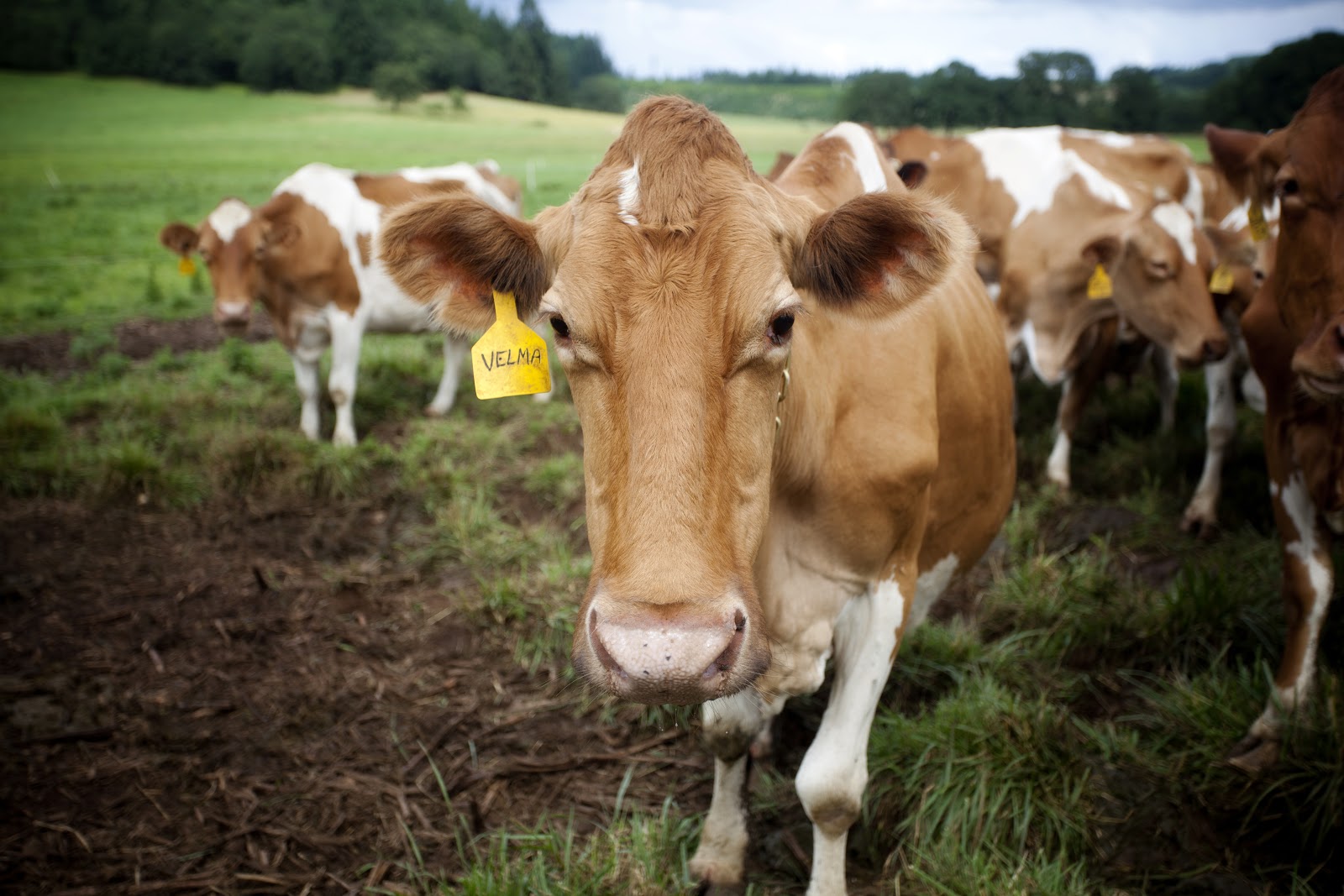

I wish I could say there was a clear and obvious path for the future here on the farm, but much of that is out of our control and dictated by the milk prices. There are quite a few updates and remodel projects we would like to take on for better efficiency on our farm. Our top priority is always cow care and comfort, the Ladies come first. I wish people knew more about how much we truly care for our animals. We don’t take care of ourselves until all the animals are cared for, for the day. We also work with a great team to make sure we are providing the best. This includes a veterinary that is on call night and day as well as monthly herd checks. A nutritionist who helps us provide the best ration for our hard working Ladies. As well as a dedicated hay grower, and a hoof trimmer who gives our Ladies a wonderful pedicure! It’s a 365 days a year job, yes the cows need to be milked twice a day every day, even Christmas, but we will continue to work hard for the lifestyle we love. There is definitely a daily sense of accomplishment when I see that milk truck leaving and I know our best possible product is inside!


Thanks Darleen for a great feature!!! Please check out Abiqua Acres on Facebook and on their blog!

Your farm or ranch can be the next FOA feature - contact Jamie or Elizabeth at foafeature@gmail.com to learn more!

Friday, December 7, 2012

Missouri Beekeeping with Erin Mullins

Today we welcome Erin Mullins. Erin is a Missouri girl who discovered the joy of beekeeping!

Hello, my name is Erin Mullins and I’m from the northwest corner of Missouri. I am 19 years old attending college to become a Nurse. I still live at home with my parents on our farm of 10 acres nestled along a creek and surrounded on 3 sides by timber.My whole life we have had animals of all kinds on our farm such as goats, emus, buffalo, hedgehogs and now more recently we’ve added bees to that list. My dad has always been interested in animals that are not so domestic and has fortunately passed that gene down to me.

Every year in January and February the local technical school offers Personal Enrichment classes for people of every age to learn about all sorts of different things. They offer classes about computers, dog obedience, flying an airplane and many more. 3 years ago I found myself going to the class they offered for beginning beekeepers. Before that class the only things I knew about bees in general were that they made honey and they stung. My cousins from Iowa had hives but I had never been out to see them up close.

So off I go notebook in hand to learn about bees. When I showed up I realize that I’m the youngest person there by about 20 years and one of only a few women. I started to think maybe I was a little out of place. The class is taught by a group of about 5-6 men from a newly founded Northwest Missouri Bee Busters who have beekeeping experience ranging from about 5 years all the way up to 30+ years. By the end of the class I learned about the different parts of a hive, diseases a bee can get, and how to harvest your honey, but most importantly a hunger to learn more. I was absolutely fascinated. Lucky for me they offered another class in February that was more advanced and went into greater detail on beekeeping.

By March of that same year I got my first 3 hives of bees. Now something you need to know is that when you buy bees you buy a “package” or box of bees it exactly that, a box that contains 1 queen and about 10,000 worker bees. It’s very intimidating when you’re riding in a car for 2 hours and a few bees escape from those boxes and are flying around in the car with you. The queen comes separately in a little tiny box, inside the bigger box, with a piece of hard candy or a cork on the bottom. The purpose the queen is separated is because if you were to release her with the other bees she would just fly off because she has not become acquainted with the other bees. So you hang her and let the bees eat the cork out and get use to her as their queen. Then for the next 5-6 months during the spring and summer the bees work to fill boxes on top of their hives called supers with beautiful golden honey. We only take the supers we put on the hives and that the bees fill so that they can have a sufficient food supply to last them through winter.

This is what you get when you order a package or box of bees.
The first year I harvested my honey I entered it at the Missouri State Fair in the FFA division. I sent a quart jar to Sedalia not knowing exactly how they judged it or if my honey was even worth sending. I don’t know if it was beginners luck or what I had was truly gold, pun intended, because I ended up receiving Reserve Champion. This past year I sent my honey again and didn’t get grand or reserve but still received a gold ribbon which I’m very proud of.

My Reserve Champion Honey from the Missouri State Fair FFA division.
Today I am a member and amateur web designer for the Northwest Missouri Bee Busters. We meet once a month and have discussions on honey prices and diseases we should check for but mostly it’s just a place for people to ask questions and get every ones opinions on the matter. It’s been said that if you ask 2 beekeepers how to do one thing you’ll end up getting 3 different answers. But that’s the great thing about beekeeping is that someone is always there with advice and information. Then basically you just have to try the different things out on your own until you figure out what works best for your operation. As a club we put on the beekeeping classes at the tech school, set up a booth at the American Royal in Kansas City, MO for the school tours, and do other talks about bees around the community.

This is the booth our club had at the American Royal in Kansas City for the school tours.
We had honey sticks for the kids and an observation hive with live bees.
I am also a member of the Missouri State Beekeeping association who meet twice a year. At those meetings they bring in scientists, professors, and experienced beekeepers to give lectures on all sorts of beekeeping related matters. It’s a great place to learn and meet some very interesting people. This past year I had the privilege of getting to know the Missouri State Honey queen. I traveled with her and her mom to St. Louis for one of the state meetings and got to see her at work. It really sparked an interest with me. I’m hoping that next year I will be able to run for the queen position. They have the opportunity to promote beekeeping and agriculture in general to kids and adults all across Missouri and even Kansas.

Beekeeping is a wonderful hobby to have that comes with many great benefits. Not only do you have the opportunity to sell your honey, bees are very beneficial to agriculture. According to The New Agriculturalists in the United States alone bee pollination is valued at several billion dollars. Bees pollinate about 1/6th of the world’s flowering plants and over 400 agricultural species. So I strongly encourage people to get into beekeeping as a hobby because what you are doing just by keeping bees, you’re also helping American agriculture an out. Plus nothing tastes better or is better for you than fresh honey right from your backyard.

For more info about beekeeping here are a few websites you can go to:
www.northwestmissouribeebusters.com – My local clubs website.
www.mostatebeekeepers.org – The Missouri State Website
www.honey.com – The National Honey Board
www.abfnet.org –The American Beekeeping Federation

Thanks Erin for the great feature. You can follow Erin on her personal blog: Diaries from the Dirt Road.

How are you involved in agriculture? We want to hear your story! Send us an e-mail at foafeature@gmail.com and we can get you started writing a feature!

Wednesday, November 28, 2012

Randy and Jared Bowen - Louisiana Cattlemen

Today we feature the Bowen's of Louisiana Randy and Jared Bowen are making it count when it matters most! A special thanks to Brittni Drennan - communications coordinator for the International Brangus Breeders Association for sharing this story with us!

There is an indescribable bond that exists between father and son relationships. A distinguished sense of pride is established when one or the other accomplishes set goals and overcomes obstacles. When dreams are achieved, success is shared between both of them. A great father and son team is hard to find, especially one that works as well as the Bowen team.


Randy Bowen and his son, Jared, share responsibilities, chores, and goals, and have the same vision for their registered Brangus seedstock operation in Marion, La. Their mission is to grow their operation to become the primary supplier of quality Brangus bulls to commercial cattlemen and, eventually, the seedstock sector. They hold each other accountable and make sure they are always on the same page.

“We plan ahead to avoid problems and learn from mistakes,” Jared said. “We talk every day about what we can do better. We emphasize communication, and whether it’s forage or breeding decisions, we work well together.”

Together, they work to enhance their breeding program while emphasizing efficiency. At Slantin B Brangus, the Bowens make it count when it matters most., They know it is essential to continually evaluate techniques and make decisions to improve management practices, especially during the harshest weather conditions this country has seen in more than 50 years. Planning and evaluating help decrease costs and determine the future success of an operation.

“We were fortunate to have gotten some beneficial rains last year, but it’s hitting us hard this year,” Randy said. “We weaned calves early this time to take the stress off momma cows.”

That is just one practice the Bowens are using to try to survive the current weather conditions. In addition, Randy said they use rotational grazing to better utilize a particular section of forages giving other pastures a chance to recover. Rotational grazing enables producers to obtain higher efficiency from their pastures. Randy said planning ahead is critical in the cattle industry and their efficiency is what sets them apart.To help minimize input costs, Randy compares feed prices, plans ahead to reduce travel expenses and carefully watches the market to know when the best time is to sell his steers.

From management plans to marketing plans, he uses his resources wisely and tries to minimize waste in every area. Randy manages the marketing aspect of the operations, utilizing inexpensive online venues such as social media to help increase visibility, build a positive reputation and market their product.

“It’s beneficial to see what other people are doing at their operations and see different bloodlines,” Randy said. “My intentions with social media are to build a brand and talk to people to build good relationships. I learn something new every week that will help me get my product out.”

Randy said advertising online improves Search Engine Optimization (SEO) when people perform a search online. He has received calls from Mississippi because someone searched for “Brangus bulls” online, and Slanting B Brangus was at the top of the search list. Randy is also impressed with the responses he has received because of his activity on craigslist, Facebook and other sites.

“Online visibility reaches more people and a bigger audience,” Randy said. “People are receiving more information online and online advertising is more flexible. When doing searches, people can be more specific and target what they are looking for.”

To further increase efficiency, Randy said he conducts research before making purchasing decisions allowing him to make smarter choices. He knows who his customers are and specifically who he is targeting with his product. As a registered seedstock producer, Randy said targeting the commercial producer provides a larger market. He gains trust from his customers because he knows what type of bull will fit their operations and their programs.

The Bowens utilize more than just online resources to build their product. Jared oversees and implements artificial insemination (AI) practices at the operation and assists other neighboring ranches with AI as well. Now a Certified Herdsman, Jared attended Bovine Elite, LLC artificial insemination and palpation clinics in College Station, Texas. Utilizing AI technology is a more efficient way to improve genetics and diversify the herd to avoid line breeding. Expected Progeny Differences (EPDs) are also used to develop their program and provide the best product to the industry.


“I think EPDs are important because they indicate the genetics you’re getting. There’s no second-guessing, and it’s not a shot in the dark when looking for a proven cow and a proven bull,” Jared said. “We look at phenotype too, but when we go back and look at the paperwork, you’re not taking as big of a risk.”

Aside from daily routines, Randy and Jared attribute the Brangus breed for making this year a success when so many other producers are selling out. Randy said Brangus is a strong breed and will continue to be more desirable among commercial cattlemen in the future. He is most pleased with the breed’s outstanding maternal instincts, longevity and adaptability to harsh environments.

“From my experience, cattleman think Brangus is a strong breed,” Randy said. “They’re protective of their young and are more resistant to diseases. Especially in the southern region, they adapt well to different climates. They forage well, are low maintenance and eat more of what maybe other cattle would pass by.”

Jared said Brangus genetics coincide with what commercial producers are looking for. Easy calving and good mothers that can grow a good calf are the type of cows his customers want. When purchasing bulls, Jared knows his customers want good temperament, docile bulls that will produce low birth weight calves.

“It’s important to know the cattleman and know his program and what he’s looking for that will fit his breeding program,” Jared said.


The Bowens maintain sight of their long-term goal to eventually supply quality genetics and new bloodlines for seed stock producers, while efficiently providing a consistent product that will satisfy customers in a time when everyone is cost-conscious. Randy and Jared do not know what the future of the industry looks like, but they are making it count when it matters most.

Thanks to Brittni Drennan - Communications Coordinator for the International Brangus Breeders Association for bringing us this great feature. Check out their website and their Blog and "like" them on Facebook.

Would you like to be the next FOA feature? Contact us today at foafeature@gmail.co
m

Friday, November 16, 2012

Missouri Farm Girl Deena Aaron

Today we welcome Deena Aaron from Lipstick, Camouflage and Farm Life as she shares with us her adventures of Missouri farm life! 

My story is about being a Missouri farm girl and loving every minute of it. My husband Richard takes care of the family farm with his 90 year old father at his side. The farm has been in my husband’s family for about 100 years and consists of 600 acres. From the time Richard’s grandfather bought a small piece of ground and slowly added other small parcels as they became available, there have always been cattle here. We now have around 100 cows and calves and Richard and I have another 80 acres where we live about 15 miles away which is my family farm where my Dad lived and where my Mother still lives. We run three bulls, moving them back and forth, a registered Black Angus, a registered Beef Master, and our newest bull just bought last month, a 10 month old registered Hereford.

 
If someone had told me 20 years, even 10 years ago that I would be this involved with raising cattle I would have never believed it. But you will now see me out nearly every night checking cattle on the four-wheeler when my husband can’t. We both still work full time, I am a Senior Secretary at the University of Science and Technology in Rolla Missouri and Richard runs his own business - Aaron’s Archery which he has owned since 1980. It is next door to our home which makes it convenient for him. On top of working full time I also do professional photography. 


As all cattle owners know there is always something to be done on a farm - fence to fix, hay to bale, tractors and equipment to be fixed, always something so we are always busy. Oh yes, and it seems pretty much always cows where they are not supposed to be. On top of all the cattle I have three sheep that come running when they see or hear me. Now that’s a funny story - mama sheep showed up as a stray sheep, I have always taken in stray cats and dogs, but stray sheep!! Really I’m telling the truth. Well after she had been there about a month I thought she was looking pretty fat and one morning I had left for work and Richard called me and said you might want to come back home and see what we have. She had twins and of course they are all here to stay. It took me several months to gain her trust and now they all three love me. She took the babies and ran off once and we looked and worried about them but she finally came back. I guess she didn’t like me locking them in the barn every night but they were so little I was worried something would happen to them. 


All of the property has been cross fenced since Richard started overseeing the farm. This year we had a drought as a lot of other people did so we have bought hay out of Northeast Missouri and had it trucked in. This has never happened before in our 28 years of marriage but no rain means no pasture like we usually have. We have worried and had a lot of sleepless nights figuring out what to do.

Baby O was the first calf born on our 80 acres and was very little, although her mom whom we call “Big O” is a big cow but Baby O was very weak. We found ourselves out in the field at 10:00 pm giving her a bottle. Now we probably worry more than we need to and are too over protective but we haven’t lost one calf at our place yet. By the way, Big O gave birth this spring to twins, which I will share later. Having said all that Baby O is now a momma and of course she had her baby in March when it was very cold and she had trouble. 


We were at the barn, got her in the head gate, Richard had his arm inside and had ahold of one of the hooves when she got loose, he lost his grip and I had to climb the corral to get away from her. That scared the heck out of me. That was my first time that a cow tried to hurt me. She just knew she was hurting and I guess thought it was our fault. We got her back in the head gate and finally Richard pulled her calf and he was a big one and both front feet were turned under so he made some braces and duct taped them on until the little guy could stand up and he is thriving and growing up like a weed. That was the second time Baby O beat the odds, she would have surely died and the calf too. The full story is on my blog. 


I also am in the process of writing a series of children’s books about our dog “Jake the Farm Dog” and am looking for someone to illustrate and publish my books. They are quite entertaining as Jake and his friend Bear get into a lot of mischief over their girlfriend “Lipstick”. More to come on that. I hope you have enjoyed our story and I have many more to tell. For instance I will just put this picture on and tell you this is Lucky Girl and we raised her on a bottle and now she is going to have a baby of her own. I’m sure when that happens it will be quite the occasion. Maybe we will have a “calf shower”. 


 By the way I am an avid Turkey Hunter and just had my picture and article published in the National Wildlife Turkey Federation “Turkey Country” October issue in “Women in the Outdoors” and have also been featured in the magazine Living the Country Life. 

 If you like my stories you can join my blog for more of my life as a Missouri Farm Girl!!

Thanks for sharing your story Deena! Be sure to visit her blog and twitter to learn more!  

If you or someone you know would like to be the next Face of Agriculture please contact us today, we need YOUR story! 

Wednesday, November 14, 2012

Dr. Ashley Stokes of Hawaii's Cattle Industry

Today we are proud to feature Dr. Ashley Michelle Stokes. Ashley is the recipient of the 2012 Hawaii Cattleman of the Year.

The recipient for the 2012 Hawaii Cattleman of the Year is Dr. Ashley Stokes, the product of multi cultural influences – a part “My Heroes Have Always Been Cowboys” - a little “Jolie Blon” and now “My Hawaii Nei” – whose lyrics tell the story of Hawaii’s Cattle Industry – “the future of this land is in our hands”.


Dr. Ashley Stokes received her Bachelor’s Degree from the University of Alabama and was the first person to enroll and complete a dual degree DVM/PhD program at Louisiana State University where she received a Doctor of Philosophy in Veterinary Physiology and a Doctor of Veterinary Medicine. While in Louisiana she received numerous professional and civic awards including the Baton Rouge “Top 40 under 40”; the “Forum 35 Board of Directors” and the YMCA of Baton Rouge Board of Advisors.

Ashley is the Associate Extension Veterinarian & Pre-Veterinary Advisor with the Department of Human Nutrition, Food and Animal Sciences of the College of Tropical Agriculture and Human Resources having joined HFNAS in August of 2009 and has made tremendous strides in both student organizations as well as in the Animal Sciences program.


She has over 50 research program interests and in excess of 80 publications. Since taking on the role of advisor of the Pre-Vet and Rotaract Clubs, she has energized both clubs and has increased membership substantially. The Pre-Vet Club introduces students to opportunities and information related to animals and veterinary medicine and the Rotaract Club is a Rotary-sponsored service club that addresses the physical and social needs of the community while promoting international understanding and peace through friendship and service projects. Some of her contributions include coordinating mock interviews and a mentorship program that connects students with local veterinarian mentors to familiarize students with the application process for veterinary school, organizing swine artificial insemination and baby animal processing and care workshops to give students valuable hands-on experiences, and devoting much energy and enthusiasm to outreach efforts that get students interested in Animal Sciences in CTAHR. Despite being so heavily involved in numerous undertakings, Dr. Stokes still finds the time to get to know her students and assist and mentor them individually so that they may achieve their educational and professional goals.


In May of 2012, The University of Hawaii recognized Ashley as the recipient of the 2012 Ka Pouhana (Mentor) Award, which recognizes an outstanding mentor in the college whom students feel, has gone beyond the call of duty and has performed an outstanding job in guiding them. The Ka Pouhana Award Selection Committee is comprised wholly of undergraduate and graduate students. In making their selection, the Committee highlighted Ashley’s focus on interactive learning experiences that engage her students; efforts in providing activities, mentoring, and advising to help her students prepare for veterinary school; and encouragement of students to set higher goals for themselves, as key traits that make her truly deserving of this year’s Award. In addition, Ashley has coordinated mock interviews and a mentorship program that connects students with local veterinarian mentors to gain experience in veterinary medicine; provided advising for students applying to veterinary schools; organized artificial insemination and neonate animal care and processing workshops to give students valuable hands-on experience; and devoted energy and enthusiasm to getting students interested in Animal Sciences and Veterinary Medicine in CTAHR.


Subsequent to her arrival in Hawaii, Ashley has been invaluable to Hawaii’s Cattle Industry and is recognized throughout the Island chain as integral to its future success. She has worked tirelessly to assist in the development of Livestock Shipping Guidelines to insure the well being of cattle in transit. Ashley has conducted workshops across the State on Beef Herd Health & Welfare as well as a forage study to develop a better mineral supplement for Hawaii Cattle. Another example of Ashley’s efforts at bringing together academia with the cattle industry included implementing and coordinating CTAHR’s Beef Herd Breeding and Artificial Insemination Classes – “Helping MOOOve Hawai‘i Beef to the Top”. Ashley was the point person on the cattle industry’s efforts to provide awareness of the prolonged and devastating drought to not only our Local & State organizations, but also on a National level with the Department of Agriculture


She has been an active partner in the implementation of initiatives not only for the formation of the Hawaii Livestock Farmers Coalition, but also for enhanced communications between all stakeholders – public & private sector alike.

Ashley is passionate in her belief that in an industry where our ranchers work hard to take care of the land and their animals they need to be recognized by the 98% of the population that are not involved in agriculture – “promoting beef is as important as raising beef”. As the NCBA and USFRA have stated - “We see an under informed consumer out there asking questions about food safety - we’ve got to be prepared to go back to the consumer and give that consumer an idea of what is happening and what isn’t happening – perception is reality.” She has been instrumental in reaching out to stakeholders & consumers alike to help communicate each other’s concerns and to provide for a better understanding for all. She is adamant about everyone realizing it really is all about people and their understanding of where their beef comes from.


Ashley truly epitomizes the Aloha Spirit and the knowledge that Hawaii’s Ranchers are about Ohana – about preserving Hawaii’s heritage and culture – about loyalty to the land and enhancing it for future generations – and most of all about perpetuating the way of life of our ranching community.

To learn more about Hawaii's Cattle Industry and Hawaii Agriculture check out these great webpages: 4Ag Hawaii and Hawaii Agricultural Partnerships, 4Ag Hawaii Facebook Page. Hawaii Beef - It's Whats for Dinner and Hawaii Livestock Farmers Coalition and Hawaii Big Island Beef.

A special thank you to the folks over at 4Ag Hawaii and the Hawaii Cattlemen's Council for sending us this great feature! 

Do you know someone who is a leader in agriculture? Does a farmer or rancher inspire you? Send them our way!! There are so many stories to tell and we need your help! Contact us today at foafeature@gmail.com to learn how to be the next FOA feature!

Wednesday, November 7, 2012

Hoffman Harvesting Inc.

Today we welcome Jada Bulgin of Hoffman Harvesting Inc., as she shares her family harvesting story with us. Hoffman Harvesting is another member of All Aboard Harvest

My name is Jada Bulgin and I have been on harvest for the majority of my life—approxi­mately 29 years. My husband, Leon, and I play an integral role in my family’s harvesting opera­tion—Hoffman Harvesting Inc. 

Leon & Jada Bulgin and Candice & Perry Hoffman.

Like myself, my father (Perry Hoffman) was born into the harvesting world where he learned the specifics of the industry as he grew up help­ing his father with his harvesting business. At the age of 17, he decided to branch off and start his own harvesting business. That is how Hoffman Harvesting began 40 years ago. The third generation, my daughter Kaidence, joined our family in July of 2009 and will hopefully enjoy the lifestyle as much as I did growing up.

Our crew moving fields in Texas. It's a regular convoy.

Go time as a harvester can be described as the time of year when harvesters get that urge to head south and hit the amber waves. This urge can only be described as an addic­tion that gets in your blood from experiencing harvest. In the sum­mer, we are on the move approxi­mately every two weeks but have our campers to call home. They are furnished with all the luxu­ries of a real home—including a washer and dryer. It serves as our home away from home.

In the field.

When on the harvest run you are never really prepared for go time until you get that nod that things are ready down south, and “we’re leaving tomorrow.” That’s when the real rush starts on our farm. Yes, it only happens once a year, and it’s a little different rush hour than living in the city. It lasts more than a couple of hours- more like days- and we run around like whirlwinds finishing last minute projects and getting everything ready to be driven out of the yard first thing.

Big jobs need big equipment.

While I have several jobs I need to do in preparation for harvest, the most fun is getting Kaidence’s room ready. This past summer I made her help carry her toys and pack them away. Some things on her list that didn’t make it were: her friend Cade from daycare, Bud my dad’s horse and every immediate family member we have. I told her they just wouldn’t fit and to my delight she seemed to absorb this news quite easily. The excitement of seeing friends of ours on the run helped further curb her disappointment from not getting to take “everything” she wanted to bring with.

Kaidence & I at her birthday party in July. It was a princess themed party.
 
I did try to explain that we were leaving for Texas and the harvest run and wouldn’t be back for awhile. Though, the concept of leaving home never struck her until we actually left home. Then as we were driving she asked, “Mommy, can I please take my dolly Holly with?” I answered, “Sure.” The conversation proceeded to go on the next couple days about all her beloved items as we traveled to Kiowa, Kan., to pick up our combines and continued on to Texas. Even after telling her that our house was traveling behind her and everything she packed was coming with, it just didn’t quite make sense until we got there.

The clean organized playroom/ bedroom combination didn’t stay that way for more than an hour once we were in Texas. And, that is when I could tell the adventure has just begun. While the drive here is never fun, we are always excited to be on harvest. 

The 40th anniversary Hoffman Harvesting crew. 

Join us as we embark on our 41st year and making memories by checking out www.allaboardharvest.com and www.hoffmanharvesting.com

Thanks Jada for sharing your story with us! To learn more about America's custom harvesters check out All Aboard Harvest, or learn more about Hoffman Harvesting on their website

Do you or someone you know farm, ranch, harvest or somehow work in the agricultural industry? We need YOUR story today! Please contact us to learn how you could be the next Face of Agriculture! 

Monday, November 5, 2012

Roland Harvesting

Today we welcome Megan Roland from Roland Harvesting as she tells about growing up in a custom harvesting family.

Growing up in a family harvesting business, I was raised with a deep appre­ciation for agriculture and its beginnings. My family has many interesting ties in agri­culture, as I had ancestors who homesteaded in the Sand Hills of Nebraska, to relatives who farmed in Iowa.

The origin of Roland Harvesting traces back to my grandfather, Robert Roland. After serving in World War II he followed the wheat harvest for a couple sea­sons and was able to experience the life of a harvester. My father, Alan Roland, recalls hearing several of my grandfather’s intriguing stories about the harvest adventures he had experienced. It is these stories that sparked my dad’s initial interest in harvest. 

Brandon & James work on setting the combine.

In 1978, my father graduated top of his class with a Bachelor of Science in Mechanized Agriculture degree from California Polytechnic State University in San Luis Obispo, Calif. During the summer of 1978 he returned to the family farm in Hemingford, Neb., and purchased his first combine, a New Hol­land TR ‘70, and harvested crops near his home area while working with a local custom harvester. Dad purchased his second New Holland TR ‘70 combine in 1979 and started to head south on harvest with the help of a small crew.
Every harvester needs the essentials. 

In 1983, my mother, Loretta, married my father and joined the harvesting business, and she accom­panied him on the road to follow the wheat harvest for many summers. A few years later our family was started, beginning with my older sister, Ashley, followed by me and my younger brother, Brandon. We were all raised on our family farm located near Hemingford and have been involved in our harvest­ing operation from birth. My siblings and I learned responsibility and work ethic at a young age. We spent countless hours riding in vehicles and combine cabs, and as we got older we have driven consider­ably more. Harvest is always an adventure and it is a way of life for my entire family.

Every summer Roland Harvesting begins our season by heading south to Texas; we gradually work our way north through Oklahoma, Kansas, Nebraska and back to Hemingford as we follow the wheat harvest. In August, we travel to Wyoming and Idaho to harvest malting barley for Coors and Anheuser Busch. During the end of August, much of the crew is lost as many of us return to college. The season is finally finished by my parents in the late fall with corn, bean, and sunflower harvest in the Panhandle of Nebraska. 

Even on the road we sometimes get opportunities to see things off the harvest trail.
This was taken at Old Faithful in Wyoming. 

Roland Harvesting is currently operating two CR 9070 New Holland combines with 36-foot draper headers. In fact, Roland Harvesting has proudly owned and operated New Holland twin rotor com­bines for over 30 years. In addition, we have three semis and grain trailers to haul the grain. A tractor and grain cart are also usually brought on the road to help with the harvest, along with two service trucks that assist with maintenance of the machin­ery. We also have a TR ’98 combine that we usually keep at the farm to help out with home harvest or to take on the road if we need to split the crew.

Our crew is primarily made up of family with some hired help but it varies from year to year. In years past, Ashley was one of the main combine operators on the crew, but since she graduated from college last year and is now in the “real world,” she is no longer able to join us for the full run. However, Ashley and my brother-in-law, Kurt, are able to meet up with us and help out during the week­ends when we get closer to home. My mom has spent many years on harvest in the past, but she now mostly stays busy at home to help take care of all the family farming operations as well as do all the necessary bookkeeping for the harvest business. My parents constantly remind me that Roland Harvest­ing would not have been successful without the help and support of extended family members and loyal customers throughout the years. Our extended fam­ily continues to be very important assets within our harvesting business as they are always willing to help when needed. 

Cutting wheat - it's our life. 

Our main crew consists of Dad, Brandon, James, Jason and me. Overall, Dad and Brandon continue to lead our harvesting business, although since we have a smaller sized family opera­tion most of our tasks and jobs overlap a fair amount. Dad and Brandon typically operate the combines, while James and Jason drive truck and haul the grain into the elevators. Jason is our excellent head mechanic and is showing James all the “ins and outs” about all the equipment. Our entire crew is also skilled in operating combines and everyone has a Class A CDL and is capable of driving semis and hauling equipment.
Being a part of All Aboard mean telling our story right from the wheat field.
I find time in between jobs to get my latest post up.

With Brandon being my 20-year-old brother and James being our 21-year-old cousin, and me just a year older, we have quite the young energetic spark within our group. Brandon has turned into an outstanding combine operator and is even beginning to polish up his new profound “boss skills.” James also grew up around harvest but this is his first year joining the crew down south.

I typically oper­ate the grain cart as well as help run combine and drive truck as needed. In addition, I carry out my duties of the job I have been dubbed—“Supply and Distribution Manager."
Dad and I in an Oklahoma wheat field.

Harvest is a very important aspect of our entire family’s lives and has provided countless memories, adventures and experiences. We like to think of harvesters as the last inhabitants of the frontier. Following in our ancestors footsteps, we continually move with the land in an attempt to make a living. Follow us, and the wheat harvest at www.allaboardharvest.com.

Thanks for the great feature Megan! You can read more about Roland Harvesting on their website and facebook page. You can check out more harvest stories and family businesses at www.allaboardharvest.com, and on their facebook page and twitter