Showing posts with label Alabama. Show all posts

Wednesday, January 9, 2013

Don and Sherry Atkinson - Brangus Producers

Today we have a post brought to us by Brittni Drennan, Communications Coordinator of the International Brangus Breeders Association. Meet Brangus producer Don Atkinson and family - they have been successful producers because they know what their customers want.

Anyone who is an expert in marketing will tell you the key to a successful marketing plan is to know your audience. When you know who your audience is, you can better serve them and market a product that fits their needs. Don Atkinson may not claim to be an expert in marketing, but he knows exactly who his customers are and what kind of product will fit the needs of their operation.

Don & Sherry Atkinson
“I want my customers to be successful in their endeavors,” Atkinson said. “I know my product and offer customers one type of cow that can thrive in their environment.”

A fourth generation cattleman, Atkinson knew at an early age what his calling was in life. Running cattle has always been a staple and a way of life in his family. Atkinson partnered with his father until his passing in 2001, and Atkinson took full ownership of the business and began ranching full time. His ultimate goal is to be remembered for creating a mother cow that thrives in her environment and maintains longevity.

Together, Atkinson and his wife of almost five years, Sherry, run 240 commercial Brangus cows and some registered Brangus cattle in Mullins, S.C. Atkinson switched to breeding Brangus when he bought his first bull in 1990 from Graham DuBose and John Spitzer. After breeding his commercial herd to the Brangus bull, he realized the advantages Brangus genetics had to offer, especially for the environment he was surrounded by near the east coast.


“People need to take advantage of crossbreeding to take advantage of all the opportunities hybrid vigor provides,” Atkinson said. “Crossbreeding allows producers to incorporate all the benefits of improved weaning weights, milk, [intramuscular fat] IMF and others.”

Shortly after buying his first bull and being pleased with his results, Atkinson went to Cow Creek’s Brangus sale in Mocksville, N.C., where he was introduced to Joe Reznicek’s breeding program. Atkinson has now been using genetics from Cow Creek for the last 21 years by utilizing artificial insemination (AI) techniques.

In 2010, Atkinson began breeding his Brangus cows to a registered Angus bull to create Ultrablack calves, following Reznicek’s model. According to Atkinson, his customers in Georgia, Florida, Mississippi and Alabama want purebred Brangus to perform better in a harsher climate. However, Ultrablack cattle enable him to market his Brangus genetics to his customers farther north of the Gulf Coast states.
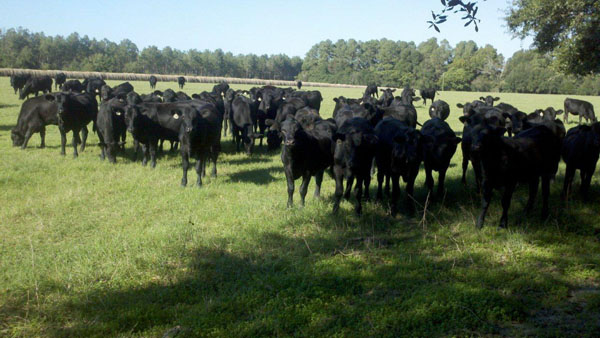

“If I’m selling to a breeder in Florida, they need to be Brangus to withstand the heat and humidity,” Atkinson said. “Here, not as many people take advantage of the heat tolerance that Brangus provide. They want Ultrablack bulls with a little less percentage Brahman blood. Registered Ultrablacks allow us to introduce Brangus genetics to those who are skeptical.”

Atkinson is especially impressed with the Brangus female’s mothering ability. His selection criteria are very strict because he knows the kind of female he needs based on his environment. Because his females are producing 75-pound calves at birth weight, he needs a tough cow that can perform satisfactorily and work efficiently.

“She’s my factory; she has got to be on the job every day of the year,” Atkinson said. “We drop our calves in November or December, and my cows have to be able to work. Brangus have excellent mothering ability, and their calves have hybrid vigor. Even with low birth weight bulls, we don’t experience any less performance in our calves. And her longevity speaks for herself. We can sell a cow as a 12-year-old and still get a good price because she’ll still perform.”

Atkinson retains his heifers to fully develop them, breeds them back, and around May 15, he ultrasounds his now bred heifers to check for pregnancy. Atkinson said utilizing ultrasound technologies extensively was key to their success. In accordance to his customers’ preferences, Atkinson able to sell them in groups so they calve within 30 days of each other, making it easier and less management for the buyer due to a shorter calving season. Atkinson is able to sell all of his bred heifers by June because he has listened to his customers and knows what they want.

“If they’re buying 20 heifers, they had rather have them calve within 30 days than within 90 days of each other,” Atkinson said. “It’s a big help on my customers’ work loads as well as on the marketing end when they start to sell their calves.”


Atkinson also implements other technologies to help him market it his cattle. He is enrolled in the OptimaxX tagging program, an age and source verification program offered by the International Brangus Breeders Association (IBBA). Atkinson said it was very easy to keep detailed records through the OptimaxX system and has been enrolled in the tagging program since it originated. In relation to cost, Atkinson said the program is very comparable to other similar tagging programs and is very proud to market his cattle as certified Brangus cattle.

“You have to live what you preach,” Atkinson said. “I sell Brangus cattle, and I carry that all the way through my marketing. At a sale, I list my cattle as sired by Brangus genetics or with an Ultrablack bull; it’s something that I’m proud of.”

Atkinson said there is a stigmatism in South Carolina about cattle with Brahman influence, but he is helping fight the negative stereotype by marketing a successful breeding program with Brangus genetics and selling Ultrablack bulls.

“I’m only 40 miles from the coast,” Atkinson said, “and my cattle have to have that Brahman influence because they do better.”

Atkinson said he prefers Brangus cattle, especially when he can get the results he desires. At Atkinson Cattle Company, bulls are strictly selected for fertility and disposition and emphasis is placed on producing a more moderate framed herd. Atkinson has received recognition and several awards for his successful program including the Commercial Cattleman of the Year by the South Carolina Cattlemen’s Association in 2007. He has also received the 2007 Outstanding Conservation Farmer from the Natural Resources Conservation Service (NRCS) in Marion County, and in 2002, Cow Creek Ranch awarded Atkinson the Mark of Excellence award.

“My favorite part is just doing what God has call me to do and go out and do what he has planned for me that day,” Atkinson said. “And raising Brangus cattle is just the chocolate icing on the cake.”


The next generation
Thank you Brittni for sending us this great feature! You can learn more about Brangus producers on their website, Facebook page and blog!

You could be the next FOA feature - contact us today to learn how!

Wednesday, November 14, 2012

Dr. Ashley Stokes of Hawaii's Cattle Industry

Today we are proud to feature Dr. Ashley Michelle Stokes. Ashley is the recipient of the 2012 Hawaii Cattleman of the Year.

The recipient for the 2012 Hawaii Cattleman of the Year is Dr. Ashley Stokes, the product of multi cultural influences – a part “My Heroes Have Always Been Cowboys” - a little “Jolie Blon” and now “My Hawaii Nei” – whose lyrics tell the story of Hawaii’s Cattle Industry – “the future of this land is in our hands”.


Dr. Ashley Stokes received her Bachelor’s Degree from the University of Alabama and was the first person to enroll and complete a dual degree DVM/PhD program at Louisiana State University where she received a Doctor of Philosophy in Veterinary Physiology and a Doctor of Veterinary Medicine. While in Louisiana she received numerous professional and civic awards including the Baton Rouge “Top 40 under 40”; the “Forum 35 Board of Directors” and the YMCA of Baton Rouge Board of Advisors.

Ashley is the Associate Extension Veterinarian & Pre-Veterinary Advisor with the Department of Human Nutrition, Food and Animal Sciences of the College of Tropical Agriculture and Human Resources having joined HFNAS in August of 2009 and has made tremendous strides in both student organizations as well as in the Animal Sciences program.


She has over 50 research program interests and in excess of 80 publications. Since taking on the role of advisor of the Pre-Vet and Rotaract Clubs, she has energized both clubs and has increased membership substantially. The Pre-Vet Club introduces students to opportunities and information related to animals and veterinary medicine and the Rotaract Club is a Rotary-sponsored service club that addresses the physical and social needs of the community while promoting international understanding and peace through friendship and service projects. Some of her contributions include coordinating mock interviews and a mentorship program that connects students with local veterinarian mentors to familiarize students with the application process for veterinary school, organizing swine artificial insemination and baby animal processing and care workshops to give students valuable hands-on experiences, and devoting much energy and enthusiasm to outreach efforts that get students interested in Animal Sciences in CTAHR. Despite being so heavily involved in numerous undertakings, Dr. Stokes still finds the time to get to know her students and assist and mentor them individually so that they may achieve their educational and professional goals.


In May of 2012, The University of Hawaii recognized Ashley as the recipient of the 2012 Ka Pouhana (Mentor) Award, which recognizes an outstanding mentor in the college whom students feel, has gone beyond the call of duty and has performed an outstanding job in guiding them. The Ka Pouhana Award Selection Committee is comprised wholly of undergraduate and graduate students. In making their selection, the Committee highlighted Ashley’s focus on interactive learning experiences that engage her students; efforts in providing activities, mentoring, and advising to help her students prepare for veterinary school; and encouragement of students to set higher goals for themselves, as key traits that make her truly deserving of this year’s Award. In addition, Ashley has coordinated mock interviews and a mentorship program that connects students with local veterinarian mentors to gain experience in veterinary medicine; provided advising for students applying to veterinary schools; organized artificial insemination and neonate animal care and processing workshops to give students valuable hands-on experience; and devoted energy and enthusiasm to getting students interested in Animal Sciences and Veterinary Medicine in CTAHR.


Subsequent to her arrival in Hawaii, Ashley has been invaluable to Hawaii’s Cattle Industry and is recognized throughout the Island chain as integral to its future success. She has worked tirelessly to assist in the development of Livestock Shipping Guidelines to insure the well being of cattle in transit. Ashley has conducted workshops across the State on Beef Herd Health & Welfare as well as a forage study to develop a better mineral supplement for Hawaii Cattle. Another example of Ashley’s efforts at bringing together academia with the cattle industry included implementing and coordinating CTAHR’s Beef Herd Breeding and Artificial Insemination Classes – “Helping MOOOve Hawai‘i Beef to the Top”. Ashley was the point person on the cattle industry’s efforts to provide awareness of the prolonged and devastating drought to not only our Local & State organizations, but also on a National level with the Department of Agriculture


She has been an active partner in the implementation of initiatives not only for the formation of the Hawaii Livestock Farmers Coalition, but also for enhanced communications between all stakeholders – public & private sector alike.

Ashley is passionate in her belief that in an industry where our ranchers work hard to take care of the land and their animals they need to be recognized by the 98% of the population that are not involved in agriculture – “promoting beef is as important as raising beef”. As the NCBA and USFRA have stated - “We see an under informed consumer out there asking questions about food safety - we’ve got to be prepared to go back to the consumer and give that consumer an idea of what is happening and what isn’t happening – perception is reality.” She has been instrumental in reaching out to stakeholders & consumers alike to help communicate each other’s concerns and to provide for a better understanding for all. She is adamant about everyone realizing it really is all about people and their understanding of where their beef comes from.


Ashley truly epitomizes the Aloha Spirit and the knowledge that Hawaii’s Ranchers are about Ohana – about preserving Hawaii’s heritage and culture – about loyalty to the land and enhancing it for future generations – and most of all about perpetuating the way of life of our ranching community.

To learn more about Hawaii's Cattle Industry and Hawaii Agriculture check out these great webpages: 4Ag Hawaii and Hawaii Agricultural Partnerships, 4Ag Hawaii Facebook Page. Hawaii Beef - It's Whats for Dinner and Hawaii Livestock Farmers Coalition and Hawaii Big Island Beef.

A special thank you to the folks over at 4Ag Hawaii and the Hawaii Cattlemen's Council for sending us this great feature! 

Do you know someone who is a leader in agriculture? Does a farmer or rancher inspire you? Send them our way!! There are so many stories to tell and we need your help! Contact us today at foafeature@gmail.com to learn how to be the next FOA feature!

Wednesday, July 18, 2012

Miller Farms

Meet Steph and Lance Miller of Alabama. This proud farming family raises cotton, peanuts, poultry and much more!


Miller Farms is located in North Alabama in an area called Sand Mountain. My husband, Lance and I farm with Lance’s Uncle Jim and Aunt Nell. We farm 660 acres of cotton, 155 acres of peanuts, 85 acres of soybeans, and 55 acres of corn. We also have four poultry broiler houses where we are contract growers for Koch Foods. The chicken houses are 43’ x 510’ and hold around 34,000 chickens each. We raise a 4lb bird in around 35 days.


My job is to go to the chicken houses every morning. Everything is automated, but I still have to make sure the chickens have feed, water, and proper heat and ventilation. I also have the job of removing any dead chickens from the houses. I’m in charge of all of the office work for the poultry operation and Lance and Jim’s farming operations. During harvest season, you can find me in the cotton field. I run the module builder. The builder is what the cotton picker dumps the cotton into when it gets full. I use levers to work a tramper which packs the cotton. After the picker dumps 12-15 bales of cotton, and I pack it tightly, a tractor pulls the module builder forward off of the cotton, and it leaves behind a module of cotton that is ready to be taken to the gin.


Lance, Jim, and our two farm employees always have something to do. In the spring, they fertilize the fields with our chicken litter, spray the weeds in the fields, and plant the crops. In the summer, the peanuts need to be sprayed every two weeks for fungus, and the cotton needs to be sprayed every few weeks with growth regulator, insecticide and herbicide. There is also a lot of bush hogging to do. They also get our equipment and tractors ready for harvest. In the fall, we harvest the crops. The corn will be ready to pick in August, the peanuts will be ready in September, cotton in October, and soybeans in November. Winter is spent on repairs, equipment maintenance and sowing a cover crop.


Lance has been helping on the farm since he could walk. He started working on the farm when he was in high school. After college, it became his full time job. Lance and I were married in October 2006, and I worked a job dealing with the public for almost a year. After I couldn’t take it anymore, Lance said he would build some chicken houses, and I could work on the farm too. Our favorite thing about working on the farm is being able to be our own boss and be around family.


We wish the public would understood how much work and labor is involved in farming. We may take in a lot of money when we get paid for our crop, but it goes right back out the door when we get all the bills. It bothers us when people think that the government pays us large amounts of money to farm, when in reality it wouldn’t even pay our fuel bill during picking season. People need to understand that if U.S. farmers are regulated and priced out of business, all of our food will be coming from other countries, which do not have the same standards as our food does.


Thanks for the great feature Stephanie! Be sure to check out her farming blog (The Life of a Farmer's Wife) to learn more about this families farm! She has a lot of good things going on!

Don't forget you could be the next feature! We want to hear your agriculture story! Contact us for more information - YOU could be the next featured face of agriculture!

Wednesday, July 11, 2012

Jan of SlowMoneyFarm

Welcome Jan, from SlowMoneyFarms. She raises rare breed rabbits and poultry, and advocates for having choices available to everyone regarding food products.

SlowMoneyFarm is a different kind of place. It's different in food choice options, and it's different in the animals we keep.

Doing videos, social media, working towards promoting not just what
we do but agriculture as a whole is part of the day. 
With a goal of having a customized opportunity featuring heirloom and heritage plants and animals used to feed people, it's more than a chance to taste what food used to be like. While it takes all sizes and types of farms to provide food choices, much like different grapes produce different wines, different breeds may have slightly different characteristics, and tastes. We wanted to work on a cash basis, without a bank loan, and have been told it's impossible.

I grew up on a farm in Illinois with Charolais beef cattle. 4-H and FFA were long time activities. After high school I attended Black Hawk East Community College, graduating in 1981 with a degree in Equine Science. I worked with horses for many years, as well as on farms. With step-grandparents raising Brown Swiss cows, I still have a fondness for that breed...maybe someday!

I've raised rabbits for over 12 years, so I was comfortable with them, and had several years raising small scale poultry. Both fit into the space we had available, starting with a 25x20 covered pen that initially housed chickens and ducks, with a net over the top to keep area owls as well as roaming dogs deterred. A few rabbit cages were tucked under the high end of the mobile home. 

Dominiques - one of the most popular breeds in 1902,
now considered rare.
Over time, we've added an 8x12 hoop house with 10x12 pens on both sides, a 12x14 hoop with a covered 6x12 area on one side for chickens, and a wing on the other side that's about 15x12' In this "big hoop and wing" we have rabbit cages, with misters that cool the air for fans to keep the rabbits cool in hot weather. Semi portable shelters are also used, and more pens are being built.

It's still growing. Literally, in size, and in volume. The rabbit cages have misters running in the aisles and fans to keep rabbits cool in hot weather - up to 20 degrees cooler even in extreme weather.

We started with a determination to grow into this, building and growing a market as well as starting where we are with what we have. In the beginning that wasn't much. Without a bank loan, everything has been small scale. We started with uncooperative ground that is on a slope, rocky in back, clay in front. Moskvich tomatoes, rosemary, several types of mint, peppers and other items cover the raised beds and other areas up front.

We raise Giant Chinchilla rabbits for show and as a crossbred sire for meat. Connor has earned his own rabbits, purebred Silver Fox and Champagne D'Argents. I also have added a few Satins and Californians to crossbreed for a growing meat business.

We have raised and have flocks to start hatching of Rhode Island Red, Dominique, Buckeye and black Australorp chickens. We also have red and white, buff and dark Cornish, Delawares, Rhode Island whites, and an assortment of birds we don't have roosters for - yet! We also have Midget White turkeys and Muscovy ducks.

Some of the Muscovy ducks.
Food choices drive us. These breeds we use were developed for small situations. The Giant Chinchilla, which is one of the largest breeds, was developed nearly 100 years ago and called the million dollar rabbit. They were developed for fur and meat, and with a characteristic of making use of hay rather than just the higher cost pellets. We don't know what the future holds, so maintaining these rare breeds may seem foolish to some, but their characteristics may be of use in an uncertain agricultural climate.

The Delaware chicken, for example, used to be crossed on New Hampshire hens for broilers. The Midget White was developed for those families who didn't need a 25 pound turkey for Thanksgiving. Many were developed by and for outdoor operations, and those operations are being sought as a food choice by a growing number of people.

We're still working towards an increased acreage operation in Kentucky, a particular area selected for the proximity to Nashville, Tennessee and Louisville. With working towards that, we need to grow not only our flocks and herds but a demand. Let people know we're here, make connections, communicate with people about food choices.

Two years ago my best friend passed away, and her son came to visit during the summer. In the spring of 2011 Connor moved here, with a discipline and typical pre-teen issues. He has cleaned pens, hauled water, dressed out rabbits and chickens, hauled manure, helped build raised beds, weeded, harvested and a host of other tasks that need done. 

A typical day starts with Connor doing critter check and watering while I check emails, see if there's any social media fires to tend to and check the day's schedule. There really isn't a "you do this job I do that one" for the most part with a few exceptions. I do the feeding as Connor's still working on the formation of proper executive decisions! I check to make sure he's properly filled the waters, as it's ultimately my responsibility to insure all the animals have water. He's a teen who did not grow up on the farm and too easily thinks "I'll come back to that" so direction to follow through raises not only the critters but his abilities. Paul is also a big part of things, holding an outside job setting mobile homes to keep the bills paid.

Generally Paul and Connor handle the building of things, the deciphering my sketches in a "make this work!" plea and many of the meals. Yes, we're not traditional - Paul's had chef training, and Connor has learned to not only raise rabbit and chicken but cook it too. Pretty good for a kid that two years ago was tapped at eggs or Ramen noodles!

The only breed of chickens developed by a woman,
Buckeyes have a long history.
I handle the social media tasks, promotion, marketing, selection of expansions, feeding, extra projects to make funds available for expansions or new things...pretty much directing the ship. When we need feed, or need a new bloodline I scout out the sources and make it happen, usually on a budget!

I wish we had the funds to get 20-40-50 acres, and believe it will happen. We have our current place almost paid off and recently purchased 10 acres in Arizona on contract that will be Connor's "savings account". He misses Arizona, and his mom of course, it's a reminder of her. As with many things, opportunity doesn't always come along at the ideal time, but we make it work! Having room for larger stock is definitely a goal!

I love working with the critters, and on Twitter as @SlowMoneyFarm often introduce myself as "head critter gitter" here, making the decisions who to sell, who to breed, who to dress out, what we need to do to get to that next step. When things crowd in, some time with the rabbits fixes everything, even if just in time to stop and appreciate what we have, rather than looking at what we don't.

Last year when the tornadoes came through Alabama, they hit just north and just south of us with devastating consequences. We'd just recently put up the first hoop and moved our young pullets into it. All came through fine. When the tornado hit, we were without power. We had just stocked up the weekend before so had groceries in the freezer as well as fridge and pantry.

I moved the cast iron pan to an outdoor grill, and although it was a much bigger production to get meals prepared, we started using the thawed food then moved to the frozen, which was thawing. We had, of course, eggs still coming. Several days without power gave a new appreciation. We lost some chicks due to the outage, but not nearly what many lost. The next day our birds got up ate and carried on. When the power came back on and we saw the news it was an eye opener. It tested survival, and cemented the decision to move forward.

Midget white turkeys.
We can only have food choices if we work together. Right now we depend on larger farms for our hay, for the feed for our animals. We have, equally, sold hens to those who just wanted a couple birds for producing their own eggs. We won't compete on volume, but offer choices. We have no illusion that rabbit is going to replace beef or pork in American consumption! But without all three farms there is less choice.

I wish more people understood that truly, we are in this together. We're not, really, competitors. The person wanting a 16 ounce Angus steak isn't going to be interested in rabbit enchiladas! The family that is watching pennies needs those less expensive but still safe eggs. But we still offer choices, and are every bit as serious...we just have different goals perhaps.

A big challenge is there isn't a lot of things *for* rabbits. It *is* a niche market. There aren't many vets who are familiar with them. We have to work with other breeders as to what works and what doesn't for illnesses, management, everything. I borrow many ideas from my fellow farmers - the misters for the rabbits, for example. I'm looking at and working towards a type of TMR ration for the rabbits using chopped hay that is easier to handle, with the pellets and supplements mixed in. I'm not content to just cruise along - but strive to make things better. 

Last year at the American Rabbit Breeders Association Convention, held in Indianapolis, Indiana, we entered the Giant Chinchillas in their first real competition since buying the first buck a few years earlier. We bred and showed two top ten does, and two top 5 bucks at the national level. Connor also had a few top 5 placings in the youth division.

Rabbits are unique, too, in that they provide fiber (angora), meat, fur and valued medical use as well as pets. The rare breeds, both poultry and rabbits, are a challenge to find stock. It seems oxymoronic to say we need to eat them to save them, but food choices allow them a job. It allows a reason for people - like us - to keep them besides purely a push for production and fast turnaround of other more modern breeds and operations. In the end - food and farm choices working together is good for everyone. 

Young rabbits, like other species, are ofter allowed a creep feeder to
allow them to access feed without the doe getting too fat.
People can find us easily on our website, Twitter and Facebook as SlowMoneyFarm. We have a farm blog at http://www.slowmoneyfarm.wordpress.com/ and more recently started one from the food side, slowmoneyfood.wordpress.com for those more interested in chicken recipes than chicken breeds. It's hoped this will bring in more people who will make choices, whatever the choice is, which then allows all of us a market to fill the choices. 

Choices are good...for all of us.

Thanks Jan for the great feature. Be sure to check out her blog and social media to follow along with her business. 

If you would like to be a featured farmer or know someone who should be, leave a comment below - or check out our contact page. To learn more about the Faces of Agriculture Project click here.