Showing posts with label Texas. Show all posts

Wednesday, June 12, 2013

Linda - Texas Ranch Girl

Today we welcome Linda – a Texas Ranch girl. This busy gal is busy agvocating and living life to the fullest on with her husband on their ranch in Texas.

From my childhood in Texas to my travels around the world - my heart has always belonged to my family and the ranch.


My family farmed rice and raised cattle in Katy, Texas - when Katy was a small farm town. Dad always told the story about his biggest decision on the school board was to buy a second school bus for the kids in the Addicks area to get to Katy High School. And now for those of you who are familiar with the area, I think there are five AAAAA high schools. My Dad was a great cattleman - my Mom a sweet Southern lady. So my childhood went from guns, horses, working cattle to piano and ballet. But I can tell you now - the horses and cattle won out and stole my heart.

We lived in the country on the ranch - my grandparents lived on either side of me. My family and our neighbors were my world and my extended family. We were so loved - so protected. We were also disciplined and had chores, but our world was so safe and secure. That did not mean we did not have trouble - but when you did - neighbors pitched in and helped - loved you through. They were all God-fearing, hard-working family oriented people. Integrity was everything - land purchases, farm deals, cattle purchases and sales - all done on a man's word and his hand shake. Life was real on the ranch - life and death - disappointments and victories - successes and failures.


I was always into mischief - but I made good grades - graduated from Katy High School - then on to The University of Texas in Austin for my B.B.A. with a major in marketing. Foleys Department Store (now Macys) hired me for their executive training program - Fashion Merchandising.

I am married to Gary and I have two sons, Scott and Christopher. So my life has been filled with all the love, laughter, and drama of two sons - and a career in fashion merchandising - and the ranch. But my travels - the famous personalities I met - the social engagements - the boys many activities - football games - fell short with my Dad the rancher. Believe me when I tell you that ranchers were way ahead of the times in the women's lib movement - you always got to work just like the guys on the ranch. The week-ends belonged to the ranch and there were always cows to work - hay to haul - pastures to mow - fences to mend - and any other project Dad could think of to accomplish while you were at the ranch. So I spent Monday through Friday in a fast paced world of fashion - many weeks in New York - but home was always back at the ranch. It certainly kept me grounded. I would go from whistling down cabs to whistling in my horses – skyscrapers to barns – executives to cowboys – delis and 4 star restaurants to campfires – drivers and limos to pick-up trucks and trailers – fast talk to slow talk – Broadway stars to star studded night skys.

If you have spent most of your time in a high stress office and not had the opportunity to saddle up and work cattle in 100 degree temps - from sun rise until the sun sets - with a bunch of cowboys who know no pain and fear is out of the question.......then you have missed the true meaning of "sweat equity". And you have missed some great stories. And that is what I want to share with you. I have traveled the road of board rooms - designer clothes - stiletto heels and I want to take you on the trail where our board room is open pasture with cows grazing - our jeans are Wranglers - and it's all about the boots and spurs.


I want you to know what really happens on a working ranch - how we work hard and play hard - how a good cup of coffee with friends and one of Gary's chuckwagon meals is better than any 4 star restaurant - how 24-7 is a way of life - and how we are always available for each other and we really do leave the light on for you.

So saddle up and join us for the ride of a lifetime. That's what it is - life!! This is one trail you don't want to miss. So let's ride out.

Thanks Linda for a great feature!! You can follow her on her blog Texas Ranch Girl.

How did you become involved in agriculture? What's your story? We need it! E-mail us at foafeature@gmail.com

Wednesday, February 27, 2013

The Showman - Myron Saathoff

Today we welcome another feature from our friend Brittni Drennan Communications Coordinator for the International Brangus Breeders Association. Meet Myron Saathoff a true showman! He began showing cattle in FFA and his career in the ring continues today.


Myron Saathoff enters the show ring grasping a lead rope in one hand and a show stick in the other trailing a line of perfectly fitted Brangus heifers. At the other end of the halter, Pearl glides alongside Saathoff following his directions. After getting set, Saathoff anxiously awaits the judge’s selection, knowing his heifer is bound to receive the prized purple banner.

Saathoff has stepped foot into many show rings over the last 40 years and is no stranger to the winner’s circle. He initially began showing heifers and steers in high school through FFA while growing up in Hondo, Texas. Now after two back surgeries, one hip replacement, and countless ribbons and awards won, Saathoff is unsure of how many more times he will be able to return to the show ring.

The earlier account was one of the most memorable moments of Saathoff’s show career. Pearl was the offspring of a champion that Saathoff bred and raised at JLS, Pearl’s dam, Tally, was awarded Show Heifer of the Year in 2003-2004, winning three of four major shows that year. Pearl was named International Champion and Show Heifer of the Year in 2009. The very next year, Tally had another daughter, Kelly, who was also an International Champion.

“I like being able to work with show cattle and demonstrate what you’re breeding and what you’re producing,” Saathoff explained. “It’s a way to advertise and showcase your operation to the public and showcase your best cattle.”


Upon graduating from high school, Saathoff attended Texas Lutheran College in Seguin, Texas, on a baseball and football scholarship and finished at Texas State University in San Marcos, Texas. He then began working at the local auction barn where his father worked before transitioning to the ranch management sector. He first worked for Larry Blackman of B2B Farms at 20 years old. He got involved in showing again this time in open shows. It was at B2B farms that Saathoff used Big Sir 75/6 and Justana 40/8 as clean up bulls, two of the Brangus foundation sires of today. Big Sir was the grand sire of Titan, who was the sire of Transformer, Big Sir also sired General, one of the maternal foundation sires of the breed. Justana was the foundation sire of Robert Vineyard’s 100 family. Both of these bulls can be found somewhere in most pedigrees popular today.

After working for B2B Farms, Saathoff managed several other operations including Escoba, T Diamond, Star J Ranch, and Star Creek Ranch owned by Curly Taylor where all the Brinks 392 progeny was developed. Saathoff tried his hand in sale management and consulting before settling in at JLS International owned by Jeff Smtih located near Devine, Texas. Now almost 13 years later, Smith and Saathoff together have more than 70 years of experience in the Brangus seedstock business.

Saathoff has built an outstanding reputation breeding numerous champion heifers and bulls. To date, JLS is the only operation to win the Futurity three times. JLS was also recognized as the IBBA Breeder of the Year in 2007, and Saathoff has been honored as Herdsman of the Year twice. However, Saathoff still has goals for the operation and feels like he still has more to learn.

“I’m still going. Nobody has produced a perfect animal yet, but we’re getting closer,” Saathoff said. “Show animals and breeding stock are becoming more similar and are looking more alike than they did several years ago.”

With approximately 550 head of cattle plus bulls and heifers, JLS is still expanding and trying new techniques. Having obtained the most desirable cattle and some of the best performance cattle in the industry, Saathoff’s primary goal now is to improve genetic consistency in the registered herd. In order to achieve that goal, JLS recently generated five cloned heifer calves from the original 915C cow. Saathoff said the only way to tell them apart is by their ear tag number, and they even came into heat within three days of each other without using synchronization. Saathoff attributes the 915C cow for contributing to the success JLS has experienced over the last 13 years with last year marking 115 descendants from the 915 family.

JLS is also expanding their operation to include red Brangus cattle and now have seven red Brangus females. Saathoff showcased their red Brangus program in the show ring last year and received Red Brangus Show Heifer of the Year. JLS has implemented a breeding up to Brangus program in order to introduce new genetics and avoid line breeding. When it comes to genetic selection, Saathoff knows what to look for, and the success JLS has had is a testament to the extensive knowledge and experience he has gained.

When selecting cattle and making breeding decisions, Saathoff’s number one priority is performance. He wants a bull that can work in the South Texas climate and tough, rugged environment, which is the ultimate reason why he likes the Brangus breed.

“I’ve had experience with Angus, Brangus, Braunvieh, and from experience, Brangus by far out did everything as far as adaptability,” Saathoff said. “Brangus were the most fertile and had the best performance and best milking ability across the board.”


Saathoff said infusing Brangus into a herd will improve milking ability and mothering ability, and he compliments the Brangus female for being the best in the industry. He believes Brangus can improve the beef industry with the breed’s tremendous adaptability qualities as long as purebred breeders produce bulls the commercial man needs and can use. The biggest challenge Brangus breeders face involves marketing.

“They need to believe in the product they are producing and market their own product,” Saathoff said. “If you believe in what you have and are knowledgeable about your program, you can sell it.”

Saathoff said it was important for the Brangus breed to obtain more accurate data and genetic markers in order to improve consistency within the breed, but also to improve the market and increase the demand for Brangus cattle. With the constant change in marketing trends, Saathoff is still trying to learn new tricks.

“I definitely still have room to learn more about marketing and how those trends have changed,” Saathoff said. “The Internet is one really good tool that I need to learn more about.”

Saathoff said he follows examples by others who were successful marketers like Glen Brinkman and Joe Reznicek, who were both very involved and knowledgeable about their respective programs, but the Internet is a marketing tool breeders can easily take advantage of. It is accessible to everyone from businessmen to cattlemen, and all it takes is getting the information out there to the people who are looking for it, and Saathoff is one who continually looks for opportunities to keep growing.

“If you’ve got the information in front of them, you’ve got a better chance of selling them something,” Saathoff said. “Like live Internet auctions are an area that we can grow in, and it’s beneficial because people can view and buy cattle without travelling.”

Saathoff’s new goal for JLS is simple- to keep improving by increasing consistency. Maybe Saathoff is slowing down, but he is not done yet. He and his wife, Neva, are supporters of the junior association, IJBBA, and Saathoff said he enjoys watching juniors show his cattle as much as he liked showing. He likes the opportunity to give youth the experience they might not otherwise have been able to enjoy. Having two children who grew up involved in the IJBBA, Tanessa Sawyer and Tate, Saathoff knows how beneficial the youth organization is.

After 41 years in the cattle industry, Saathoff knows how to seek out and take advantage of the opportunities before him. He has made a name in this business and created a reputation built on integrity, and his reputation alone is what markets his cattle, selling close to 200 bulls on the ranch each year.


“Honesty is what has made JLS successful,” Saathoff said, “and everyone is treated the same regardless of experience in the breed or business.”

Among a library full of memories made in the show ring, Saathoff recalls another memorable moment in 2004 when the National Western Show was first hosted in Phoenix, Ariz. That year, JLS brought back both big prizes of Grand Champion Heifer and Grand Champion Bull. Another outstanding memory was in 2003 when JLS won Grand Champion Heifer at the Futurity for the third time by the same breeder. This third win allowed Saathoff to be the first person to take home the Brangus Futurity trophy engraved with all the past Futurity winners. This trophy had previously been displayed at the IBBA office and is now proudly displayed at JLS.

Saathoff is a true cattleman and showman!

Thanks Brittni for bringing us this great feature! To meet more Brangus producers check out their webpage, blog and Facebook page.

How are you involved in agriculture? We want to hear your story! Contact us a foafeature@gmail.com for more info about being the next feature!

Wednesday, November 7, 2012

Hoffman Harvesting Inc.

Today we welcome Jada Bulgin of Hoffman Harvesting Inc., as she shares her family harvesting story with us. Hoffman Harvesting is another member of All Aboard Harvest. 

My name is Jada Bulgin and I have been on harvest for the majority of my life—approxi­mately 29 years. My husband, Leon, and I play an integral role in my family’s harvesting opera­tion—Hoffman Harvesting Inc. 

Leon & Jada Bulgin and Candice & Perry Hoffman.

Like myself, my father (Perry Hoffman) was born into the harvesting world where he learned the specifics of the industry as he grew up help­ing his father with his harvesting business. At the age of 17, he decided to branch off and start his own harvesting business. That is how Hoffman Harvesting began 40 years ago. The third generation, my daughter Kaidence, joined our family in July of 2009 and will hopefully enjoy the lifestyle as much as I did growing up.

Our crew moving fields in Texas. It's a regular convoy.

Go time as a harvester can be described as the time of year when harvesters get that urge to head south and hit the amber waves. This urge can only be described as an addic­tion that gets in your blood from experiencing harvest. In the sum­mer, we are on the move approxi­mately every two weeks but have our campers to call home. They are furnished with all the luxu­ries of a real home—including a washer and dryer. It serves as our home away from home.

In the field.

When on the harvest run you are never really prepared for go time until you get that nod that things are ready down south, and “we’re leaving tomorrow.” That’s when the real rush starts on our farm. Yes, it only happens once a year, and it’s a little different rush hour than living in the city. It lasts more than a couple of hours- more like days- and we run around like whirlwinds finishing last minute projects and getting everything ready to be driven out of the yard first thing.

Big jobs need big equipment.

While I have several jobs I need to do in preparation for harvest, the most fun is getting Kaidence’s room ready. This past summer I made her help carry her toys and pack them away. Some things on her list that didn’t make it were: her friend Cade from daycare, Bud my dad’s horse and every immediate family member we have. I told her they just wouldn’t fit and to my delight she seemed to absorb this news quite easily. The excitement of seeing friends of ours on the run helped further curb her disappointment from not getting to take “everything” she wanted to bring with.

Kaidence & I at her birthday party in July. It was a princess themed party.
 
I did try to explain that we were leaving for Texas and the harvest run and wouldn’t be back for awhile. Though, the concept of leaving home never struck her until we actually left home. Then as we were driving she asked, “Mommy, can I please take my dolly Holly with?” I answered, “Sure.” The conversation proceeded to go on the next couple days about all her beloved items as we traveled to Kiowa, Kan., to pick up our combines and continued on to Texas. Even after telling her that our house was traveling behind her and everything she packed was coming with, it just didn’t quite make sense until we got there.

The clean organized playroom/ bedroom combination didn’t stay that way for more than an hour once we were in Texas. And, that is when I could tell the adventure has just begun. While the drive here is never fun, we are always excited to be on harvest. 

The 40th anniversary Hoffman Harvesting crew. 

Join us as we embark on our 41st year and making memories by checking out www.allaboardharvest.com and www.hoffmanharvesting.com

Thanks Jada for sharing your story with us! To learn more about America's custom harvesters check out All Aboard Harvest, or learn more about Hoffman Harvesting on their website. 

Do you or someone you know farm, ranch, harvest or somehow work in the agricultural industry? We need YOUR story today! Please contact us to learn how you could be the next Face of Agriculture! 

Friday, October 26, 2012

Misener Family Harvesters

Today we welcome Emma of Misener Family Harvesters! This family follows the harvest from the Texas/Oklahoma border all the way to the North Dakota/Canadian border!

I woke up this morning in my smaller-than-average sized bed, to the wonderful sound of rain hitting the camper roof. Although it was a day of taking it easy, there are always those few things that can’t get themselves done. The trucks need to be dumped at the elevator, fueling and servicing still needs attention. This may be a nothing-to-do sort of day, but trust me. This day is nothing like a typical day on harvest. My name is Emma Misener and I am a custom harvester. I work with Misener Family Harvesters, Elk City, Okla., where I work for my mother, Kristy and along-side my brother Dan.

In 1971, my father, Ron, started Misener Family Harvesters after serving as an Army Sergeant in the Vietnam War. A few years later he was hired by a neighbor who had just moved to the area. It was that job where he met the farmer’s daughter and the rest became history. Dad and Mom built a family and business, and both thrived. They began traveling south to the Texas/Oklahoma border with combines harvesting wheat from one farm to the next, working their way north to the North Dakota/Canadian border. Once wheat harvest came to a close, fall harvest began and they worked their way back home harvesting as they went. Their tradition still lives on today.

I was born on the harvest trail, raised on the harvest trail, and still live on the harvest trail. I remember taking along my crayons and paper in the combine, riding with mom while harvesting. By the time I reached 10 years old, I had already began to beg Dad to let me drive the big machines, and by then I’m sure he was ready to at least let me try. My first field of wheat I combined was 3.75 acres and I still remember what he said. “You’re doing an excellent job, but it looks like you’re chasing a snake!” I just smiled and said, “I promise I’ll learn to drive straighter. Will you please let me have my own combine?” I’ve been driving big green machines since.

As the business grew the family did, too. I am the youngest of six children. My older sisters Marie, Katie, and Elizabeth and my brother David, soon left and started families of their own. To help fill their void Dad and Mom decided to hire help. By the time I was 15 years old I was training hired men. When interviewing potential employees, one of the questions he asked them was, “can you listen to a 15 year old girl?” They always chuckled thinking he was joking, but Dad was very serious about it.

Two years ago in December, my Dad passed away. His love and passion for harvesting still lives on today in my Mom, my brother Dan and I. Mom, Dan, and I continue his legacy harvesting the trail where it all began. Mom still does the cooking and the business, with Dan and I helping her through it all. Although it is harder to go on without him, we still have the motivation he passed down to keep us all moving forward.

We are in blistery and rainy South Dakota finishing up our fall harvest, combining corn.

Our day begins at 7:30 a.m. with breakfast, followed by a trip to the elevator with trucks filled the previous night, and then head out to the field. Mom usually packs a lunch for us to take in the morning, and once in a while she will surprise us with hot lunch. We arrive at the field, fuel up the combine, and service it by greasing the proper places, checking the oil, and then do a ‘walk-around’ checking belts/chains or anything else that seems out of the ordinary. Then the fun part begins. Once we start harvesting corn we go until the elevator closes, and then fill everything one more time for a morning trip. Once the trucks are full we head home, clean up, eat supper, and get to bed. There isn’t much time for anything other than harvesting.

I love our way of life. I love the smell of the crops, the dust in the air, and the sense of accomplishment when a field is harvested. It makes me want to do it all over again. I’m getting the itch to get back home to warmer Oklahoma, but in two months I’ll be itching to get back on the road.

Our stops on the road become home. Every place is different and has its own unique beauty. The people we hire, the people we cut for, and fellow custom harvesters become family. Even the people at the grocery stores or gas stations say ‘Hey! When did y’all get back in town? We’ve missed you!’

It can be stressful and a lot of hard work, but I wouldn’t choose any other way of life. The U.S. Custom Harvesters, Inc., go by the motto ‘we harvest the crops that feed the world’. This sums it up. I’m proud to be a custom harvester. We really do feed the world.


(L to R) Me, my brother Dan, my Dad Ron, and my Mom Kristy. This was the last family photograph before my Dad passed away. We were at the John Deere Fall Festival in Waterloo, Iowa celebrating antique tractors. My Dad loved restoring the ‘Ol’ Girls’ and went to every antique show we could go to.

We load our semis and move to our first stop on the harvest run. Most of the time we haul the combines because our stops from farm to farm are far enough away, that it’s cost efficient to haul them.

Other times, our farmers are closer together so we drive the combines from one farm to the next. It just depends on how far our farmers are from each other.


Cutting wheat in Oklahoma! We make rounds all day long in a clockwise motion so that we can always unload on-the-go.


We unload each combine one by one, then dump the grain into the waiting semis, where they then take it to the elevator.


My Dad was a very patriotic man; something that he has definitely passed on to me and the rest of my family. Every year, we put new American flags flying from each of our machines.


Every day of my life is a blessing. I love what I do and wouldn’t change a minute of it!


Thank you Emma and the folks from All Aboard Harvest for this great feature!!! If you’d like to follow along with Misener Family Harvesters during our summer harvest - visit www.allaboardharvest.com, or our Facebook page at www.facebook.com/MisenerFamilyHarvesters . You can reach Emma at emma@allaboardharvest.com.

YOU can be the next Face of Agriculture Feature - Contact us today!!

Friday, August 24, 2012

The Jasik Family

Today we are delighted to have a feature written by Brittni Drennan the Communications Coordinator for the International Brangus Breeders Association (IBBA). We hope to continue to work with Brittni and bring you more features like the Jasik's!

There are a few producers in our demanding, competitive industry who inspire all of us to work harder, be more optimistic, and strive daily to achieve our goals while building integrity instead of just a product. These hardworking cattlemen were building fence with their fathers before they were old enough to go to school and driving tractors well before they had their license. They are those kind of producers whom you hold a high respect for. Meet the Jasik family.


Dustin grew up in the little quiet town of Pleasanton, Texas, where he learned all about the cattle business from his dad, Larry. Dustin worked alongside his dad and followed his every step. Everything Dustin knows about feeding cows, herd management, buying bulls and even fixing fence, he learned from his dad.

“My dad is my biggest influence. He raised me and he’s my best friend,” Dustin said. “We help and learn from each other. I guess that’s how we make it as partners.”

Larry and Dustin partnered to establish “Jasik Hay Farms”. They now run close to 500 Brangus cows for commercial production and have 1,300 acres for coastal hay production, but it was not a short road getting to that point. Dustin started his own business from scratch at age 14 when his dad helped him buy his first set of cows. Just three years later, he leased some land and bought 50 Brangus cows. Dustin, who solely through perseverance and hard work, built a successful business without having anything handed to him.

“If you’re starting from scratch, you have to start out small and grow from there,” Dustin said. “We started from nothing 18 years ago, and being a first generation farm sets us apart.”

Dustin’s biggest critic, he said, is his wife, Kate. The young couple met at a dance after Kate moved from Comfort to Pleasanton when she was 18. Kate was unfamiliar with the agriculture industry growing up, and had limited knowledge about the cattle business. Much like Dustin learned from his father, Kate learned from her husband and took new challenges head on.


“I didn’t know anything about cattle before I met Dustin,” Kate said. “He taught me everything I know. Now we just like to drive around and look at cattle on the farm together.”

Kate contributes significantly to the success of the business. While the guys are sorting cows, she examines the quality and helps with culling. With a smile on her face the size of Texas, Kate doesn’t mind getting her hands dirty. She drives the tractor and helps harvest hay in the summer.

Kate also does the marketing work for the family business designing and placing advertisements, managing the website and publicizing the farm on Facebook. She said there are numerous advantages to using social media, and she uses several venues to publicize the family’s achievements and create awareness and publicity for their business. Using platforms such as Facebook directs people to their website and increases visibility. After advertising their big win in San Antonio last year, Kate said she saw an increase in traffic to their Facebook page and website.

“Social media is a source of free advertising that increases publicity without the cost of print advertising,” Kate said.

Other than exploiting Facebook and the farm’s website to increase interaction with customers, Kate is working on starting a blog. She said because more and more people are joining the social media movement, it is advantageous for producers to utilize these new tools to more effectively communicate with a new audience.

“I think there are a lot of younger people wanting to stay in the ag business but don’t have the resources. Advocacy draws people to our industry,” Kate said, ”and our industry must keep up with the times and explore new ways to communicate with young people.”

Between feeding cows and helping her husband, Kate does not miss a beat even with a little one on her hip. The couple had a boy, Barin, in May 2011 and are proud to raise him on a farm learning the cattle business just like Dustin did.

“We live here on the farm and working together allows us to spend more time together,” Dustin said. “We get a lot of joy being able to raise our son on the farm and look forward to teaching him a lot.”

The Jasik family has faced difficult challenges just like other producers have recently. Dustin attributes their continued success to being self sufficient with their hay production and the quality of their Brangus cattle.


“We drive on quality in our replacement females. That’s what we raise and what we market,” Dustin said. “We’re not necessarily trying to grow in numbers. We focus on quality and strive to keep satisfied customers, raising what they want and need, and that’s heifers that will breed easily, milk well and handle well.”

Dustin mentioned several reasons why he breeds his commercial cows to Brangus bulls. He said the primary reason he likes Brangus is the breed’s ability to perform in the harsh South Texas climate. Brangus cows breed back more easily, are more docile, handle better and have very little udder problems from what Dustin has experienced. Additionally, he said they always seem to top the market without fluctuating.

“There’s a market for Brangus bull calves or female calves. Brangus adapt well to different climates, they’re hardy, good quality and good breeders with good mothering-ability,” Dustin said.

Dustin said he responds to their customers’ needs and continually focuses on improving quality. To ensure this high quality, Dustin and Larry enroll their females in the Brangus Gold program, a service provided by the International Brangus Breeders Association (IBBA) that verifies Brangus genetics in commercial females.

“Having been using Brangus Gold for a year, [it] validates quality. The tags reassure our customers who are buying our replacement females that we’re breeding to registered Brangus bulls,” Dustin said.

The Jasiks take pride in the business they have built. They consider their biggest reward winning the San Antonio All-Breed Sale Overall Grand Champion in 2011. This was only the second time in the last 19 years that the Brangus breed received the title. They have also had several Breed Champion Brangus Bred Heifers and Pairs over the last eight years.

The Jasiks have an inspiring story to tell- one of tough challenges and many triumphs. Families like the Jasiks motivate us to work harder and live better.

“You can’t just give up the first dry spell you hit,” Dustin said. “You can’t give up because it will pay off in the end.”

Thank you Brittni for this great feature! Be sure to check out Gobrangus.com and their Facebook page and blog. To learn more about the Jasik's visit their webpage and blog.

Remember - we need your stories to make this blog possible. Contact us about being a feature!

Friday, June 22, 2012

Rachel and Damon

Meet Rachel and Damon - a couple of Texas ranchers who have agreed to share their story with us today.

Howdy from Texas, y'all!

We were asked by Elizabeth, of Circle the Wagons, to write our agricultural story for the Faces of Agriculture blog. We are glad to be here!

Damon, and I (Rachel) along with our 3 boys, are cattle ranchers in the Big Bend area of far west Texas. A vast, beautiful land in it's own characteristic.


We both grew up knowing this way of life. I was raised in southeast New Mexico. My folks raised sheep, cattle, and farmed cotton, and grew feed such as corn, alfalfa, wheat, and other forage for the livestock.

I come from a long line of farmers and ranchers. My dad's family moved to the area from Texas many, many years ago, and homesteaded. My brothers and I grew up always helping out, hard work and responsibility were instilled in us from the beginning. From early on I knew that when I grew up was going to have a job in a major part of agriculture, and as I got older ranching became the goal. It's the only thing I knew! I grew up doing anything and everything, from sheep to cattle to horses and everything in between, my dad taught us everything he knew. My mother worked right along beside my dad, just as I do for Damon.

Damon was raised in this area of Texas. His great-grandfather moved to this area from Gonzales County, Texas and bought what is now our home place, back in 1908. (If interested he wrote book called "The Dream of a Youthful Cowboy", a book about his life, how he became a cattle rancher, and stories along the way.) So Damon came from a ranching heritage. There isn't much farming in this area. Where it is done, there is a flat that someone decided to break out. You see very little farm land. When his great-grandfather moved here, his words were- "the man with plow could never come." I do believe he was wanting away from farming.


Shortly after graduating high school, Damon went on to Clarendon College, in Clarendon, Texas, to graduate with his Ranch and Feedlot Operations (RFO) degree. He worked for ranchers along the way and finally returned to this area later on. Damon already had a herd of cattle put together. He had been gathering them up since graduating high school. He ran cattle with his parents, and came down to help out anytime they needed him. Because of that, we had a good start to ranching when we married 5 1/2 years ago. After a few years of saving our money, training horses and working on making our small herd better, we were able to lease some land, and from there our herd grew.


We run a cow/calf operation on range grass. Mostly Corriente cattle, which we run J-Bar Braunvieh and Gelbvieh bulls with. The cattle we had from the start are large frame crossbred cows. The Corriente cows do very well at our leased land, they get out on the rocky hills and find the grass there is, that the other cattle won't look for, and they handle the harsh climate very, very well. With their smaller frame they don't need as much grass either. By breeding them to big framed bulls, we get the large frame and weight on the calves that they need when sale time comes. When weaned we hold them for about 30-60 days, depending on the feed situation. In the past three years we have sold our calves to a local man whom buys for a feeder in Oklahoma.


When we first leased land we had a good summer and got plenty of rainfall. Going into the winter though, times started getting hard. We had little winter moisture and by the time spring/summer rolled around things were looking dry. This began the year and half drought that was widespread throughout Texas, New Mexico, and Oklahoma. It of course led to buying feed, and by then the price of feed was rising well above it's normal price.


We do feed cake, a range cube, throughout the winter, and also put molasses tubs out. The cattle didn't do as well as needed with this. With the harsh winter, record cold, and no moisture going into the spring/summer (and none coming) we decided we needed to step up the feed supplement. We chose to use Anipro, a very well proven brand of liquid feed, and other supplements. Later on we started using their mineral supplement, as well. We did have a slow breed up with cattle during that time, and sold about 11 head that were light bred. We received much more rain at the leased land later that summer that a lot of people in the area never saw, and for that we are thankful. The cattle did do much better with the little green grass and feed we had set out for them.

Winter came in again without any moisture, we sold 20 more head of cattle, because the grass was getting very scarce, and as we made it through this spring, we have received more rainfall than we had the year before. Summer begins soon, and we have had very hot days, praying that our rainy season, normally starting in July, will bring the moisture we need to see us through. 

Our home place saw fire last spring, and of course the drought. We have 20 head of cows left there, sold over half the herd because of fire and drought. We fed those few cows alfalfa hay throughout the winter, and of course mineral and liquid feed. With the small rainfall we have received lately, the grass is still just trying. Nothing has greened up, but we are waiting and hopeful.

Our day to day work consist of whatever needs to be done. Each day we never really know exactly what we will be doing. We do a lot of checking on the water tank, troughs, and of course the cattle. There is the regular upkeep of fences, and windmills or water wells, as well. The cattle need water, and the summer heat can make it hard to keep it for them, as in the winter if it's very cold, we break ice. We also clean the troughs and tanks out when necessary. You wouldn't want to drink yucky water, would you?

There is also the rotation of pastures, which requires horseback work. And, then there are the times we wean calves in the fall, and the branding or marking of the baby calves which we have coming up here in the next week or so. This type of work is what we enjoy the most, being horseback is soothing, and because we raise our own horses it's nice to ride good ones that know what they are doing and have a level head.


Our three boys, young as they are, 4 1/2, 3 and 14 months, even help out in any way possible. Especially the horseback work. The eldest is a good hand, the other two are learning the ropes but they are learning to do work and have responsibility. This way of life is work, it's determination, and you can not sit back and watch or nothing will get done. There is little time off, and hardly ever a vacation. But, it's a good life. A down to earth good way to live, and especially to raise children to know where all of their food comes from and how to work for the things they need or want. 

We are so thankful the Lord has allowed us to live this way, to be out and about to see what He has created in this world. The big blue sky, the vast land, and the animals. It's all beauty in our eyes! God is the root of it all, everything we have is His. We follow Him, and ask that He leads us in the way He wants. A true blessing to raise a family, and be cattle ranchers! Drought or no drought, it's all in His hands.

Thanks for reading our story! 

Thanks for the great feature! Rachel and Damon have a blog, however it is private. They love new readers though, so just send an e-mail for an invite. Here is a link to their profile.

If you would like to be a featured farmer or know someone who should be, leave a comment below - or check out our contact page. To learn more about the Faces of Agriculture Project click here.

Monday, June 11, 2012

Chad Cunningham

Meet our very first Faces of Agriculture Feature - Chad Cunningham! (Photos taken by Kim Goldsmith of Putnam Texas)

Chad, Tom & Hannah
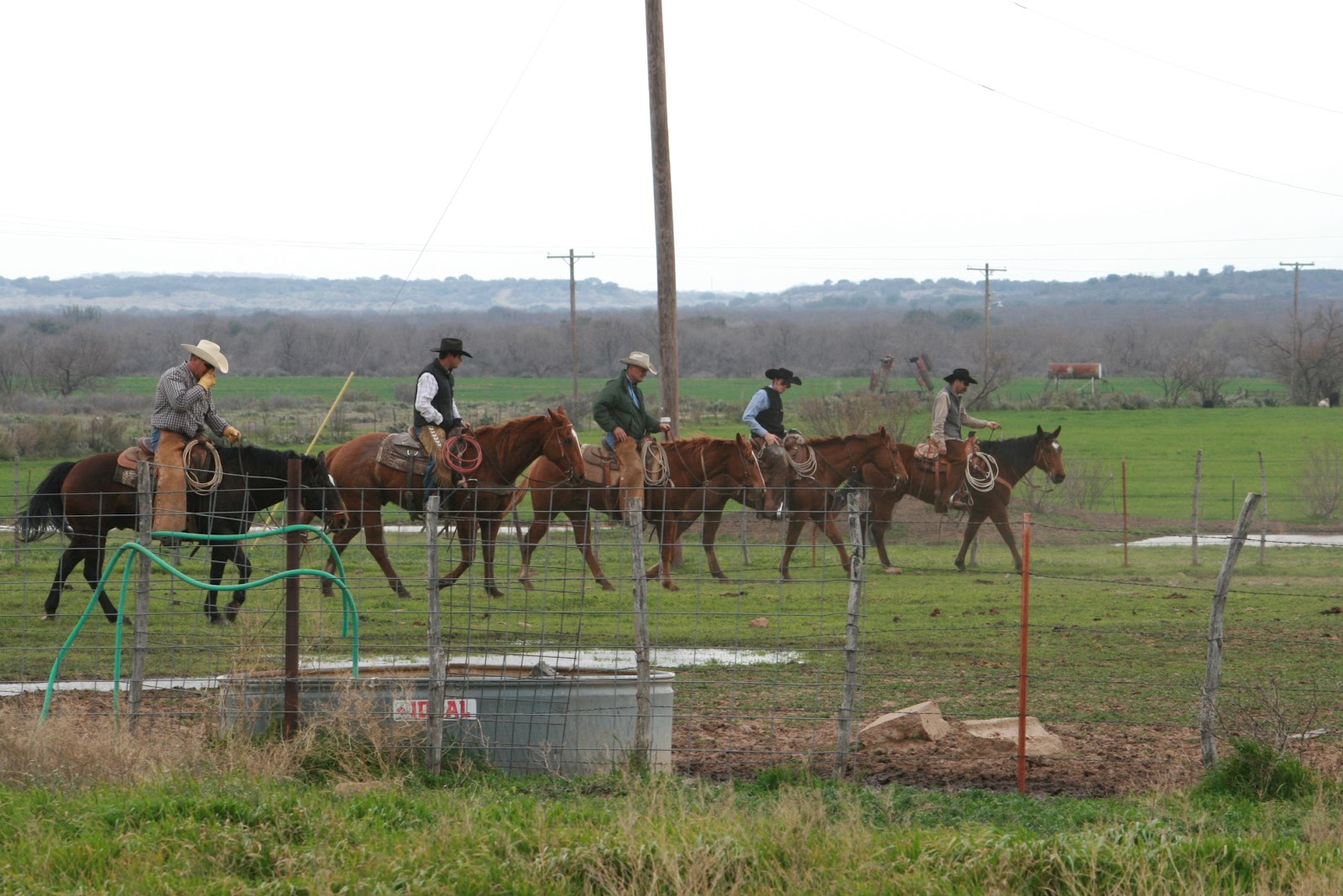
Meet Chad Cunningham a real Texas cowboy and cattle producer. He is the owner and operator of a cow/calf and yearling operation. The ranch is a family business. Chad and his son Kyle with one other cowboy Joe run the ranch while his daughter keeps the books. His wife Kim has the chore of keeping all the cowboy's fed (which is no small task!).

Heading out for a day of work.
Chad's son Kyle. 
Ranch cowboy, Joe. 
Together this family lives and works on the land to get your food from pasture to plate. Chad's main business is running yearlings. They buy 450 - 650 pound calves, and let them grow until they weigh 750 - 850 pounds, then send them to the feedlot to finish.

Chad sorting calves. 
Chad does very little "farming". He says, "We are all a lot better horseback than we are in a tractor seat. The yearlings work good for our part of the country. When it is dry, we don't buy as many, when we get some rain, we buy more cattle. Plus, you get to stay horseback a lot more with yearlings than you do mama cows."


Agriculture is all about getting down and dirty!
His blog at Chad's Stuff showcases his cowboy heritage with photos of him and the guys working cattle, and riding horses. Chad also makes spurs and knives. He is keeping Western traditions alive and well.

A set of Damascus spurs made by Chad.
Thanks Chad for our very first feature! Be sure to head over to his blog and learn more about the cowboy's life! 

If you would like to be a featured farmer or know someone who should be leave a comment below - or check out our contact page. To learn more about the Faces of Agriculture project click here.