Anyone who is an expert in marketing will tell you the key to a successful marketing plan is to know your audience. When you know who your audience is, you can better serve them and market a product that fits their needs. Don Atkinson may not claim to be an expert in marketing, but he knows exactly who his customers are and what kind of product will fit the needs of their operation.
 |
| Don & Sherry Atkinson |
A fourth generation cattleman, Atkinson knew at an early age what his calling was in life. Running cattle has always been a staple and a way of life in his family. Atkinson partnered with his father until his passing in 2001, and Atkinson took full ownership of the business and began ranching full time. His ultimate goal is to be remembered for creating a mother cow that thrives in her environment and maintains longevity.
Together, Atkinson and his wife of almost five years, Sherry, run 240 commercial Brangus cows and some registered Brangus cattle in Mullins, S.C. Atkinson switched to breeding Brangus when he bought his first bull in 1990 from Graham DuBose and John Spitzer. After breeding his commercial herd to the Brangus bull, he realized the advantages Brangus genetics had to offer, especially for the environment he was surrounded by near the east coast.

“People need to take advantage of crossbreeding to take advantage of all the opportunities hybrid vigor provides,” Atkinson said. “Crossbreeding allows producers to incorporate all the benefits of improved weaning weights, milk, [intramuscular fat] IMF and others.”
Shortly after buying his first bull and being pleased with his results, Atkinson went to Cow Creek’s Brangus sale in Mocksville, N.C., where he was introduced to Joe Reznicek’s breeding program. Atkinson has now been using genetics from Cow Creek for the last 21 years by utilizing artificial insemination (AI) techniques.
In 2010, Atkinson began breeding his Brangus cows to a registered Angus bull to create Ultrablack calves, following Reznicek’s model. According to Atkinson, his customers in Georgia, Florida, Mississippi and Alabama want purebred Brangus to perform better in a harsher climate. However, Ultrablack cattle enable him to market his Brangus genetics to his customers farther north of the Gulf Coast states.
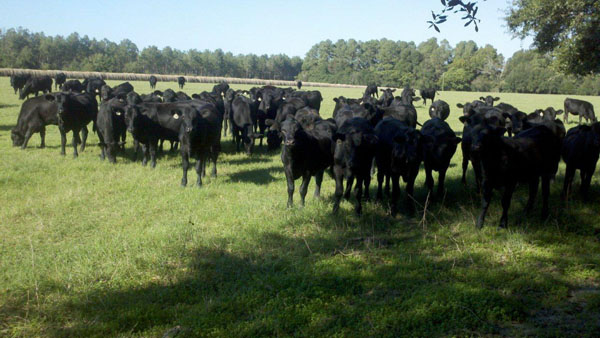
“If I’m selling to a breeder in Florida, they need to be Brangus to withstand the heat and humidity,” Atkinson said. “Here, not as many people take advantage of the heat tolerance that Brangus provide. They want Ultrablack bulls with a little less percentage Brahman blood. Registered Ultrablacks allow us to introduce Brangus genetics to those who are skeptical.”
Atkinson is especially impressed with the Brangus female’s mothering ability. His selection criteria are very strict because he knows the kind of female he needs based on his environment. Because his females are producing 75-pound calves at birth weight, he needs a tough cow that can perform satisfactorily and work efficiently.
“She’s my factory; she has got to be on the job every day of the year,” Atkinson said. “We drop our calves in November or December, and my cows have to be able to work. Brangus have excellent mothering ability, and their calves have hybrid vigor. Even with low birth weight bulls, we don’t experience any less performance in our calves. And her longevity speaks for herself. We can sell a cow as a 12-year-old and still get a good price because she’ll still perform.”
Atkinson retains his heifers to fully develop them, breeds them back, and around May 15, he ultrasounds his now bred heifers to check for pregnancy. Atkinson said utilizing ultrasound technologies extensively was key to their success. In accordance to his customers’ preferences, Atkinson able to sell them in groups so they calve within 30 days of each other, making it easier and less management for the buyer due to a shorter calving season. Atkinson is able to sell all of his bred heifers by June because he has listened to his customers and knows what they want.
“If they’re buying 20 heifers, they had rather have them calve within 30 days than within 90 days of each other,” Atkinson said. “It’s a big help on my customers’ work loads as well as on the marketing end when they start to sell their calves.”

Atkinson also implements other technologies to help him market it his cattle. He is enrolled in the OptimaxX tagging program, an age and source verification program offered by the International Brangus Breeders Association (IBBA). Atkinson said it was very easy to keep detailed records through the OptimaxX system and has been enrolled in the tagging program since it originated. In relation to cost, Atkinson said the program is very comparable to other similar tagging programs and is very proud to market his cattle as certified Brangus cattle.
“You have to live what you preach,” Atkinson said. “I sell Brangus cattle, and I carry that all the way through my marketing. At a sale, I list my cattle as sired by Brangus genetics or with an Ultrablack bull; it’s something that I’m proud of.”
Atkinson said there is a stigmatism in South Carolina about cattle with Brahman influence, but he is helping fight the negative stereotype by marketing a successful breeding program with Brangus genetics and selling Ultrablack bulls.
“I’m only 40 miles from the coast,” Atkinson said, “and my cattle have to have that Brahman influence because they do better.”
Atkinson said he prefers Brangus cattle, especially when he can get the results he desires. At Atkinson Cattle Company, bulls are strictly selected for fertility and disposition and emphasis is placed on producing a more moderate framed herd. Atkinson has received recognition and several awards for his successful program including the Commercial Cattleman of the Year by the South Carolina Cattlemen’s Association in 2007. He has also received the 2007 Outstanding Conservation Farmer from the Natural Resources Conservation Service (NRCS) in Marion County, and in 2002, Cow Creek Ranch awarded Atkinson the Mark of Excellence award.
“My favorite part is just doing what God has call me to do and go out and do what he has planned for me that day,” Atkinson said. “And raising Brangus cattle is just the chocolate icing on the cake.”

 |
| The next generation |
You could be the next FOA feature - contact us today to learn how!