Wednesday, September 19, 2012

Jennifer and Travis - Nevada Ranching Family

Please welcome Jennifer and Travis to Faces of Agriculture. This Nevada ranch family is proud to be involved in agriculture and bring food to your table. (photo credits to Heidi Stevens.)

Hello, my name is Jennifer. My husband Travis, our 2 boys and I live on a ranch in the beautiful Ruby Mountains near Lamoille, Nevada. It is said that “Behind every successful cowboy is a wife with a good job in town!” We are no exception. Like many ranch wives, I have a job in town. I tried teaching High School Agriculture for a couple of years, but learned that I was better suited to older students and now teach Animal Science at Great Basin College in Elko, Nevada. I have a bachelor’s of Science in Agriculture Education from Montana State University.


I work alongside Travis for Maggie Creek Ranches. Travis is the foreman here on the Lamoille division. We take care of beef pairs but primarily run yearlings from May to October. Lamoille is arguably one of the prettiest places in Nevada and we are so blessed to live where we do. We have an apple orchard in our back yard and the gorgeous Ruby Mountains in our front yard. There is plenty of room for our boys to run and grow.

One of the best things about our job here is that Maggie Creek is a family ranch and we get to take our boys to work with us whenever we want to. This is very important to my husband and me. We both grew up on ranches working with our families. It is not uncommon to drive past one of our fields and see me leading one horse with one son and riding with a kid in front of me, or see my boys helping us rebuild fence, playing in a supplement trough while Travis and I doctor a yearling nearby. Most parents buy expensive playground equipment for their kids, we have trees to climb, antique farm equipment and miles of pasture for ours to play.


Maggie Creek is a cattle operation. We run cattle on range that isn’t adequate for any other type of crop, or suitable for living. It gives us a sense of pride to know that we are taking sunshine and grasses that are indigestible to humans and creating a healthy delicious food for people. We are committed to producing a safe and wholesome product for the world.

My parents ranch near Mountain City, Nevada. My great grandparents originally purchased the ranch in the 1930’s, and our family haslived on this ranch ever since. My great granddad brought the first Black Angus cows to Northeastern Nevada. They have run strictly Black Angus since then; my dad has worked really hard to make it one of the best herds in the state. I hope to one day go home to Mountain City to ranch, making my boys 5th generation ranchers in the area.


Travis and I come by ranching very naturally as you can tell. We have started our own herd of black cows and look forward to teaching our boys where their food comes from and the same lessons of hard work, determination, and perseverance our parents have taught us.

I love all aspects of raising cattle. I remember being 4 years old and my mom gathering up my little sister and me in the middle of the night to help my dad pull our first calf out of a Registered Angus cow our parents bought for us from Thomas Angus, making calving and winter one of my favorite times of the year. There is nothing cuter to me than watching a baby calf switching its tail as it nurses. I also love spring and branding. Then in the summer comes a lot of saddle time as we doctor yearlings and check on calves. Fall with the weather turning cooler comes shipping time- that bittersweet time of the year when we sell our calves and we can see what all our hard work was for.


We do this because we love this way of life and the livestock, and it gives us great satisfaction to know that maybe we made a difference somewhere. Maybe it was for the calf we saved from the creek, or the person who buys one of our steaks, but a difference none the less, and we enjoy our job!I always tell Travis a bad day cowboying beats a good day teaching!

Thank you Jennifer for the great feature and for sharing your story with us! You can keep up with this ranching family with her blog Ramblings from a Ranch Wife

If you would like to be the next Faces of Agriculture Feature - Contact us! We need your story today!

Monday, September 17, 2012

Austin Black - Missouri Cattle Producer

Today we meet Austin Black - a photojournalist and 4th generation cattle producer from Missouri!

Hi, my name is Austin Black and I'm from Central Missouri. My family owns a small cow/calf operation in the West Central part of the state and my mom operates a freelance writing and speaking business out of her home while my dad pastors at a small country church and works construction full time. Although I'm not actively involved with the home operation these days, I work as photojournalist for MFA Incorporated, the regions largest feed & farm supply company.


Growing up, I was extremely active in 4-H showing cattle, horses, hogs, and even sheep for a few years. Being involved in this realm strengthened my love for agriculture tremendously. As a 4th generation cattle producer, I was nurtured and developed to love the lifestyle that raising cattle created. Caring for the livestock, seeing the baby calves grow, making breeding, management and purchasing decisions, and sharing the life with family is what makes being a cattle producer something I cherish.


But being a cattle producer isn't always a fun and enjoyable job. Our farm is located over an hour away and my dad tries to check on stuff 2-3 times a week. Fortunately, he works in that area on a somewhat regular basis, so it makes it a little easier. But it's quite honestly a chore and an expense to make the drive and care for our livestock. To say the least, doing general maintenance, herd management, and monitoring the farm is typically an all day ordeal no matter how much actually get done. During the drought, we were watering our fall calving herd and some young heifers out of two stock tanks that needed refilling about every other day. But it never matters how far of a drive, how expensive the fuel, or how tired we are, the cattle require our care and it's our responsibility and our duty to provide the best care possible.


One thing I wish people understood about livestock operations is the fact that farms and ranches have to operate as a business these days for people to have a livelihood running them. Too many consumers believe that if a farm is run “efficiently” to “make a profit”, they must be providing less than adequate care for their livestock. It saddens me that every other industry in the world is praised for making advancements in technology, becoming more efficient, and ensuring environmental stability but agriculture is accused of getting too big and too industrial. I'm afraid consumers don't realize the magnitude of demand that US agriculture is required to meet through its production. This production demands efficiency and quantity, but never loses sight of quality. Every family farm that comprises the 98% of agriculture enterprises in the US is dedicated to raising and producing the safest, healthiest, more affordable food available.


I'm Austin Black, and I'm proud to be the Face of Ag!

Thank you Austin for a great feature! You can follow Austin on his blog Off the Beaten Path. Austin also has a freelance video and photography business - you can find it on Facebook by clicking on this link and visit his webpage!  

Don't forget - YOU can be the next Face of Agriculture Feature - Contact us today!!!! 

Friday, September 14, 2012

Farmer Bright's Dairy

Today we welcome Ryan Bright, a.k.a. "Farmer Bright" as he shares with us his story of how he came to work full time on a dairy farm alongside his father and un

When people ask me how long I've been farming I always have a hard time answering them. I've been a full time dairy farmer since I graduated the University of Tennessee with a degree in Animal Science, but my mom would tell you that my first word was "tractor." I guess you could say farming is in my blood.


I am part of the 5th generation to live and work on our Tennessee dairy farm. My earliest memories are going with my father to the farm. Every summer I had two baby calves to raise that I was responsible for. While I might have terrorized some innocent farm cats, I had plenty of chores to keep me busy growing up. I think the lessons I learned through hard work and responsibility as a child greatly influenced the values I hold now. 


Today we milk around 100 Holstein dairy cows. My day begins before the sun comes up when the first thing I do is to bring the cows in from the field. While those are being milked I feed our dry cows (that is the pregnant cows) and all of our calves. After that I help finish milking in the milk barn and finally eat breakfast! And you are right if you think milk is the centerpiece of my meal! The middle part of the day is spent working in the fields or fixing things until it is time to feed and milk again.


We raise wheat, rye, and rye grass, in the winter for silage that we store in upright silos. In the summer we plant corn, pearl millet, and sudan sorghum for silage. We also bale as much hay as we can. Everything we harvest is for the cows. 


I work on the farm alongside my father and uncle. They have been full time farming since their father passed away while they were in their teens. My grandmother was the biggest advocate for agriculture in my life before I even recognized what she was doing. I knew she was very proud of our farm that her parents and grandparents had begun. My first bit of agvocacy was being in part of a slide show on our farm she made to bring the Agriculture in the Classroom project to Tennessee. She instilled in me the belief that farmers need to share their story with consumers. I've often wondered what she would think of how farmers use social media to speak to others if she were still alive today and how she might use it.


I am on Twitter @farmerbright and I also write two blogs. The Udder Side is told from the tongue-in-cheek perspective of the cows on our dairy reporting on The Farmer. Silo Skies is a more straight forward blog that I use to share what we're doing on the farm and other agriculture issues.

Thanks for sharing your story Ryan! It take dedicated and hard working people like Ryan to provide food to feed America each day. Remember - if you or someone you know would like to be featured as a Face of Agriculture, please contact us! We need your story!

Wednesday, September 12, 2012

Amanda Radke - Agvocate and Cattle Rancher

Today we are proud to feature Amanda Radke from South Dakota. Amanda is an active voice for agriculture - writing for several beef industry publications.

Howdy from my family ranch located near Mitchell, SD. My husband, Tyler, and I, live in the corner of Davison County. We are the only house in the section (No neighbors! Although my parents live on the next section just a half-mile away); we are the last house on the electrical pole, so when the electricity goes out, it stays out for awhile; we are 20 miles from the closest internet tower, which means I have bad service, making it difficult as I blog from home; and, when it snows, we are the last house to get plowed out. We’ve spent 11 days snowed in with no electricity -- talk about living like Laura Ingalls Wilder!


I’m a fifth generation cattle rancher -- the third to live and work on our ranch. My family raises purebred Limousin cattle. NOLZ Limousin offers bulls and females for sale by private treaty. www.nolzlimousin.com. We also raise corn, sedan grass and hay -- both round and squares. One of the first investments my husband and I made in our first year of marriage was a square baler; Tyler drives, and I ride the rack. Thousands of “idiot cubes” later, we still enjoy working together (although sometimes I wish it was him on the rack, not me!) We both have off-farm jobs for cash-flow purposes. Tyler works at Lynch Livestock as a hog buyer, and I’m a freelance writer for several beef industry publications. You can read my blog at www.beefmagazine.com.


Shortly after we got married, we purchased our dream place, which bumps right up to my parents’ pasture and has beautiful, well-maintained cattle facilities and the perfect pasture for our replacement heifers. This was a huge purchase to make at age 23, so we have buckled down in our spending and have focused on paying off that debt and saving for cattle down the road. But, we know what our goals are, so it doesn’t seem like much of a sacrifice. We are doing this together, and we love it.

We both have deep roots in the cattle business and want to be able to continue this tradition to the next generation. We are very passionate about the land and quality livestock, and it’s something we sit around the dinner table -- eating homegrown beef and my garden-fresh vegetables and fruits -- discussing.

A typical day for me: Wake up and do chores, tinker around the garden, take a walk or run around the section with our dog Allie, and head to the house and settle down with my laptop tackling deadlines and submitting my blogs, columns and articles as required by my editors. I take breaks or adjust my writing schedule as needed with cattle chores outside. On days I know we will be busy weaning, working cattle or baling hay, I write late into the evenings or have long all-day sessions in preparation to be outside all day. I have a smartphone, too, which enables me to work on the go. I take great pride in cooking healthy meals for my family, and I make an effort to get Tyler and I to sit down and eat together in the evenings. This is no small task, as we are usually busy outside working. Tyler gets home from work around 3, and that’s when his second job starts -- taking care of cattle, fixing things (he is our resident mechanic) and doing other chores as needed. My dad had three daughters, so he welcomes a son with open arms. It’s great to see them work together.


Our days end on our back deck. Tyler and I love to watch the sun go down on our pasture. Cattle graze on the rolling hills. It’s a beautiful sight that can reduce me to tears. I just feel so incredibly blessed to live where I do and work at a job that I love. The peace and serenity country living offers us is truly rare in today’s society, and we wouldn’t trade it for all the gold in the world.

I have traveled all over the country as a speaker at many agriculture conferences, and in my travels, I meet many consumers who don’t necessarily understand what we do. I’ve been called a murderer. I’ve been likened to Hitler, killing steers just as the Nazis killed the Jews. I have been called heartless. I have been accused of not caring about the animals. Not only are these statements hurtful, but they are so off-based. Cattle are my life. It’s hard to make a buck in the beef business; in fact, many years we are in the red. I wish consumers understood the blood, sweat and tears that goes into this business and know that we aren’t in it out of greed (trust me, there are easier ways to make a dollar); we are in it because we truly love the land, the animals and this way of life.

In 2011, I published a children’s book, “Levi’s Lost Calf,” which helps tell the beef production story to young people. I welcome the opportunity to visit schools and libraries to read my book and visit with kids about who we are in animal agriculture.


I’m a country girl. Plain and simple. But, I love connecting with urban folks in my travels. Although sometimes I feel like we are world’s apart -- we have a lot in common, too. We can talk fashion, food (I love SUSHI!), families, working out, college, goals for the future, etc. It’s in these commonalities where we can make connections and bridge the gap between rural and urban America. As a writer, that’s what I try to do. As a rancher, I know it’s what we need to do. And, as a consumer myself, it’s what I hope to hear from other farmers and ranchers as I go grocery shopping.

Thanks Amanda for sharing your story and for all that you do!! Be sure to follow her on the Beef Magazine Blog!

You can be the next Face of Agriculture Feature! - Contact us today! We need to hear from agriculturists in all walks of life!

Monday, September 10, 2012

R.C. Smith of Polk Creek Farms

Today we welcome another feature from Brittni Drennan of the International Brangus Breeders Association. Meet R.C. Smith. He is a veteran and attributes integrity for his success in seedstock production.

From the United States Marine Corps’ (USMC) All Weather Attack Squadron 533 (VMA(AW)-553) to cattle rancher in western Arkansas, RC Smith is a man of intelligence who knows his genes and has worked his way to the top.


Smith grew up in Oden, Arkansas, on the farm he now owns and manages which his family started in 1904. Smith transformed Polk Creek Farms into a successful, registered Brangus breeding operation, but not before he thoroughly researched the facts.

Smith has an extensive educational background. After high school, he attended the University of Kansas on a Naval ROTC scholarship where he received a Bachelor of Science in Accounting in 1983. He then attended flight school after he was commissioned in the USMC. After flight school, he joined Marine All-Weather Attack Squadron 533 (VMA(AW)-553), attached to Carrier Air Wing 3 and the USS John F. Kennedy aircraft carrier. While serving as a Bombardier/Navigator in the A-6E Intruder, Smith completed two “Med Cruises” on the JFK, totaling almost 300 arrested landings before being assigned as Marine Officer Instructor (MOI) at the Naval ROTC Unit at Northwestern University in Evanston, Ill. While serving as MOI, Smith obtained his Master’s Degree in Business Administration with a concentration in Finance at Northwestern University’s JL Kellogg Graduate School of Management in 1992. Upon graduation, he resigned his commission and was hired by Credit Suisse First Boston in New York City as an associate in their Mergers and Acquisitions group. Ten years later he retired from a position as Head of Mergers and Acquisitions for SunTrust Banks in Atlanta, the ninth largest bank in the U.S., and moved his two children back to his hometown in Oden where he had high hopes for the family farm.

Smith bought the family farm and its herd of quality mixed-breed cattle but was interested in breeding registered cattle. After extensive research into cattle that would be suitable for his environment and would be in high demand, he decided on the Brangus breed.“Primary benefits are the maternal abilities. They’re just good mothers and take care of their calves,” Smith said. “In addition to their heat tolerance, their longevity is important; I’ve had cows 16 to 18 years old still producing quality offspring on my farm. ”

Smith has always had an eye for cattle since he was the top-rated livestock judge at the state FFA competition his senior year in high school. However, after being out of the cattle business for several years, he knew he could not get started without some help. Smith received some advice and insight from the likes of Don Hall of Benton, Ark., and Finis Welch in Centerville, Texas. “Don was influential in getting me into the Brangus breed,” Smith said, “and I purchased most of my foundation females through Finis’ production sales at Center Ranch. Both men exercise sound judgment and are of the highest integrity; if they tell you something you can take it to the bank.”

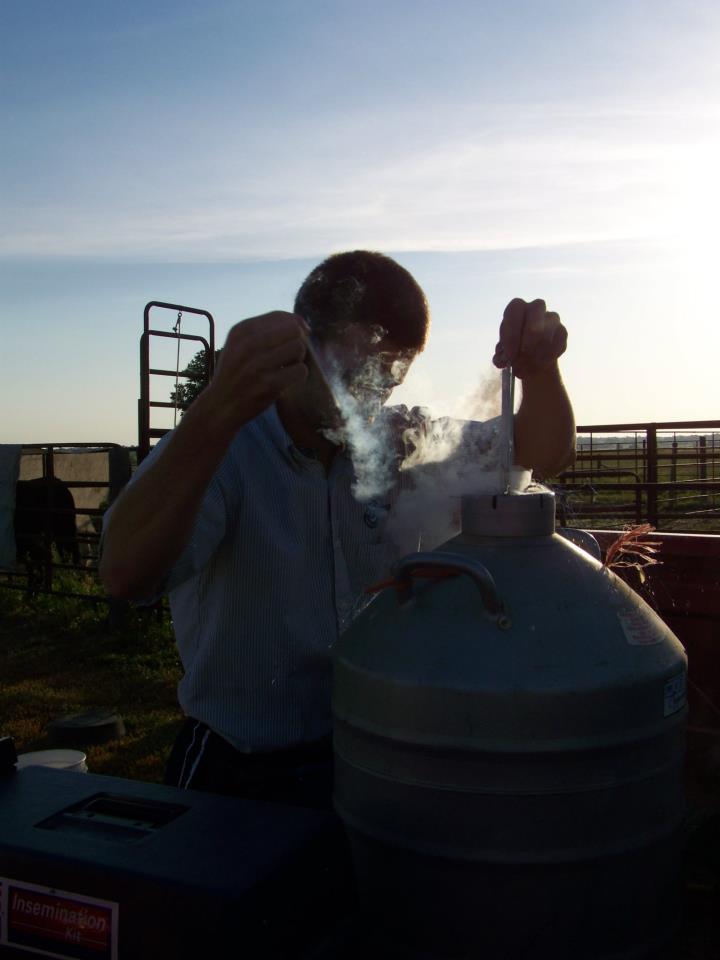
Having a thorough background in accounting, Smith looked at the mathematical aspect of the business and put the numbers to work, utilizing the most advanced techniques offered today.“I knew early on that I had to do my homework. I needed to buy the best genetics I could afford and then build my herd through artificial insemination and embryo transfer,” Smith said. Among the registered purchases, he bought proven donor cows, primarily Brinks, Center Ranch and Salacoa Valley bloodlines, for embryo transfers, utilizing his best quality crossbred females as recipients. He also applied artificial insemination techniques to take advantage of the most proven and breed leading genetics. “I purchased a heatwatch system and AI’d every female, keeping them away from the bulls until 24 days passed in order to AI again if necessary,” Smith said.

After this, the cows were cleaned up by quality bulls purchased from Camp Cooley, Doguet’s Diamond D Ranch or top-end bulls Smith had bred. He also looked at expected progeny differences (EPDs) and requested production records to inspect calving intervals before going to a sale or purchasing cattle. When purchasing bulls to utilize in his herd, Smith said he looks primarily at EPD’s and confirmation, but that was just as important as the consistency of the bull’s dam. “I will not use a bull in my herd unless it is out of a cow that produces one of the top calves in her respective herd almost every time she calves,” Smith said.

Smith retains the top cut of his heifer calves to use in his registered herd, constantly striving to increase the quality of his cattle. Smith said he culls extensively, dropping the bottom 15 to 25 percent of the registered cows out of the herd in order to make way for new heifers or new purchases. “These are typically high quality cattle but just not quite good enough to retain in the registered herd,” Smith said. “They are in high demand among my customer base, though, as commercial brood cows.”

While Smith is striving to develop a herd of good-tempered cattle with exceptional depth of body, thickness and eye appeal, he also realizes commercial buyers have a variety of preferences.

“I’ll be honest and tell the customer the strengths and weaknesses of that particular animal and let the customer determine which animal is right for them,” Smith said. “They need to find a breeder they can build a relationship with and trust in the long term. You’re buying honesty and integrity as well as the animal, and you want somebody that will treat you fairly.”

Ten years in the registry business, Smith now has 65 registered, breeding age females down from 110 a year and a half ago due to the record drought conditions that drastically impacted the South. But he has goals to increase his herd size while improving consistency in producing deep, thick, long calves.

Polk Creek Farms has also been successful in the show ring. Smith’s children showed the Grand Champion Heifer at the Arkansas State Fair for five consecutive years in the early 2000’s. He has also won national titles with calves he has sold, including the 2008 IBBA Show Heifer of the Year shown by Abby Jorgenson of Tyler, Texas. In addition, Polk Creek Napoleon 99T ranked seventh in the IBBA show bull standings two years ago, while his current junior herd sire, Polk Creek Genghis Kahn 146W2, was ranked fifth in the world last year. Both Napoleon and Kahn, as Smith refers to them, were shown by Randy Deshotel and his three daughters of Ville Platte, La., who helped Smith get involved in showing cattle.

Deshotel said Smith is meticulous and honest in his record keeping and knows how to breed for genetics. He weighs at birth, at weaning, utilizes sonogram testing, uses Total Herd Reporting (THR) correctly and uses the IBBA registry system to its full potential. But Deshotel encouraged him to begin improving the phenotype in his herd for the show ring to help market his cattle.

“We show for him on the show circuit and can help him market his cattle on the national level,” Deshotel said. “That helps when he’s located in such a secluded area.” Deshotel said they have done very well and been successful with Smith’s bulls and heifers. Deshotel’s daughter, Allison, won IBBA’s photo contest with a photo she submitted of one of Smith’s heifers which is published on the cover of the IBBA publication, Frontline Beef Producer. The Deshotel family has built a relationship with Smith and become friends since Smith joined the Brangus community. Deshotel said he holds a high respect for Smith because of his character and integrity.

“You meet all kinds of people in this world, and I have a very high respect for veterans. Smith carries that honor with him,” Deshotel said. “He keeps his word, and I think that is why he’s successful.”

In addition to being a Brangus seedstock producer, Smith teaches business statistics and quantitative methods at Henderson State University in Arkadelphia, Ark. His son, now 19 years old, works in Fayetteville, Ark., and his daughter, 16, was recently accepted to the prestigious Arkansas School for Mathematics, Sciences and the Arts.

Thank you Brittni for introducing us to another great cattle producer! You can learn more about Brangus producers on their webpage and check out the Beef Tips Blog and Facebook page.

You can be the next Face of Agriculture Feature - contact us today!!

Friday, September 7, 2012

Homestead Hill Farm

Welcome Tom & Barbara Womack as our first farmers from Virginia to share their story! Tom and Barbara have a small diversified farm where they sell their produce at the farmer's market, but their real passion is for growing food!

Greetings from the Shenandoah Valley of Virginia! 


We are Tom and Barbara Womack of Homestead Hill Farm. We own and operate a small, diversified farm specializing in seasonal vegetables, lamb, chicken and eggs. Our products are available for sale at the Staunton/Augusta Farmers’ Market on Saturday mornings. Since we are located just 12 miles from town, we can assure you that everything we sell is truly LOCAL.

If someone had told us twenty years ago that we would be able to make our living at the Farmers’ Market, we would have laughed. I don’t think we had even shopped at a farmers’ market twenty years ago. But, when life events caused us to begin from scratch in 1997, one thing led to another…and here we are. Our girls were very little when we moved here, and they had the experience of a lifetime growing up in the country on a small working farm. There have been some true learning adventures along the way. We have always worked well as a team, and now that our daughters are all grown-up, married and living elsewhere, it’s just the two of us working together here on the hill. While there are days when the work is hard and frustrating, I cannot imagine any lifestyle more rewarding than growing food.

Our farm is an ever-evolving entity. Over the years we have raised eggs for wholesale, sold vegetables to fancy restaurants, and baked well over 15,000 loaves of bread. (for ten years we sold bread at the Market) We have had milk cows and pigs and LOTS of chickens, for a long while our youngest daughter had a pony…and we even had a llama and a herd of goats for a while. We’ve been shepherds for the past ten or eleven years. But, the Farmers’ Market has been the one constant during all these ventures. Presently, we focus on our large gardening operation, two hoop-houses in which we grow greens year round, 2 small greenhouses for propagation, a layer flock, pasture-raised broilers in the summer, …and a flock of sheep. Our small farm is nothing, if not diverse.

Being vendors at a Farmers’ Market means that life around here revolves around Saturday morning Market. Our schedule and routine is far from typical. While most other folks are still in their warm and comfy beds, dreaming sweet dreams, we are up and packing our wares to get them to the Market. It’s still very dark at 5am when Tom heads out to the Market. He is also the Market Manager, so he gets there earlier than most of the other vendors to get things ready for the day. It’s my job to feed all the critters and make sure the farm is tended before I head into town as well. We may have the only sheep in the county that come running when they see a flashlight! 


While the five hours that the Market is open may not sound like a long time, when you add time for set-up and clean-up, we get a pretty intense workout on Saturday mornings before all the goodies are sold and it’s time to head back to the farm. It is rare that we bring much home, but any leftover vegetables are later processed for off-season sales.

I love the camaraderie of the Farmers’ Market. Since this is our fifteenth year in the same place every Saturday morning, I suppose you could say we have become fixtures in the downtown scene. We have seen a lot of changes over the course of all those years. There are a lot more folks concerned with knowing where their food comes from, and knowing who grows it and how than ever before. Items that no one had ever heard of are now becoming sought after and some new things have become immensely popular. Many of our customers have become friends over the years and it’s always fun to exchange recipes and learn new things. Our Market has live music a lot of weekends, so the atmosphere can be quite festive.

The human interaction at the Market intrigues me. In recent days, it has been noted that most folks are two to four generations removed from the farm. Most of these folks have NO clue what goes into farming or food production. There are those who think that small farms must be better than “big ag”, but I beg to differ. There are so many different ways to raise food, and all of them are crucial to supplying the demand. I love sharing our own experiences, as well as attempting to clear up some of the mis-perceptions about agriculture in general. To that end, I started blogging about our farm (and other random things) several years ago. It’s always humbling to meet one of my “fans” at the Market. I hope you’ll read it as well… follow at Homestead Hill Farm or LIKE us on Facebook


At the end of each Market, it’s nice to head back to the farm for lunch and a restful Sunday before getting back to work with our focus on the next selling day. Because, we don’t just sell stuff on Saturday… the Staunton/Augusta Farmers’ Market is a PRODUCER ONLY market… so, we must grow everything we sell. That means we are almost always starting seeds, transplanting seedlings, harvesting, or removing spent crops in order to plant new ones. If we aren’t in the gardens, or the hoophouses, we are feeding sheep, gathering eggs or processing broilers. There is always something to do.

A number of years ago, one of our customers suggested we consider selling year ‘round. We talked it over, changed up our growing patterns, and developed a customer list. This will be our fifth year of offering all sorts of farm products for downtown delivery in the off-season to a group of loyal customers. It works well for everyone….the customers get fresh greens/lamb/eggs/chicken/vegetables all winter and we are able to have positive cash-flow…even in the dead of winter. 


As much as I love selling at the market, I must say that lambing season is my favorite time of year. Our ewes are bred to lamb in January, so that we can get the lambs on the ground while things are relatively calm in the gardens and hoophouse. This timing also allows the lambs to be fairly good sized before they are turned out on grass in the early spring. I have often likened lambing season to Christmas morning on steroids. You never know what’s going to happen. While there are the occasional losses and frustrations, the winter lambing barn is a great place to spend some quality time. The sheep keep the grass mowed throughout the summer and provide some of the best lamb products any non-vegetarian has ever eaten!

While the sheep are great, and have earned a special place in my heart, I wouldn’t want to overlook the chickens. Our laying flock is quite productive, and farm fresh brown eggs are one of the most popular items at the Market. We also run a several batches of “broilers” throughout the summer months to provide our customers (and ourselves) with pasture-raised chicken to use in all their favorite recipes. The chickens also do their share by eating weeds, spent crops and vegetable waste. 


Yes, we might have laughed twenty years ago if someone told us we would be making our living growing and selling vegetables, but this is the good life…raising food. We will never be big producers, and some folks might discount farms of our size. That’s okay. There are a lot of folks that depend on us to grow good food for them. We haven’t been doing this for generations, but our daughters learned a good work ethic that they have carried into their adult lives.

At the end of a productive day, there is a great sense of accomplishment knowing that what you do for a living really matters to someone. Add to that living in a beautiful place, being with someone you love, and having time to enjoy it all…this is the GOOD life.

Thanks for the fantastic feature Barbara! It takes all kinds of farmers and advocates for agriculture to keep the food supply in this country running. Be sure to check out Barbara's blog and Facebook page. If you or someone you know would like to share your story on Faces of Agriculture, please contact us today! No need to have a blog or social media, we want to share everyone's story!

Wednesday, September 5, 2012

Tales from a Kansas Farm Mom

Today we welcome Nicole Small from Kansas! She is passionate about farming and teaching the next generation about where their food comes from!

Hi my name is Nicole Small. My husband, Randy, and I farm together in Southeast Kansas. We are both the 5thgeneration from each of our families to farm in the same county in Kansas as our ancestors. I work full time on the farm with my husband. My father-in-law retired in 2007, but still likes to come see where he can help out. My parents and mother-in-law help on the farm when they are needed. They help the most with the care of our two wonderful boys and are great taxi drivers when we need to move equipment or we need a ride home at night.


Our farm is unique in that both my husband and I have college degrees and we both work on the farm together full time. I tend to take care of the cattle decisions and management and he helps me when things are slower in the crop fields. He makes all of the cropping decisions and puts up with a lot of irritating questions from me about why we do things the way we do. I am a think outside the box kind of girl and sometimes that doesn’t go over so well.

We have a commercial cow/calf operation. Most of the cows calve in February and March, but we do have a small herd that calves in the Fall. In the Summer and Fall when the cattle can find the nutrition they need from their grass, I help with the crop farming. I help haul fertilizer and water to the sprayer, run the combine during harvest, do lots of errands and do most of the paperwork. Randy helps me out during calving and processing time.


Our goal is to care for the land and resources that we have been given and leave them better than when we started. We have been 100% no-till for the last 14 years. We are constantly implementing new farming techniques and using science to make the right decisions. We have over 20 landowners that trust us to make the right decisions for their farms. In addition, we have two young sons that may want to come back to the farm some day and we want it to be in the best conditions possible if they choose to come back. Caring for the resources that have been given to us can be a huge burden, but incredibly rewarding at the same time.


We have 2 boys that like to help us out on the farm. Each year they are in charge of any bottle calves we may have and do a great job with the chores. Next year, they will both be in 4-H and I can’t wait to see them grow and learn about new things each year. Here is our oldest son showing his registered Limousin heifer at the county fair this summer.


I love to volunteer with kids especially in 4-H. Every year it seems that I have earned a new son or daughter from the support and guidance I have given them. These kids are the future of America and I feel a responsibility to help them achieve their goals. There were many people who supported and guided me in my youth and I feel it is my responsibility to help these young people like I once was supported.

I also enjoy going into classrooms to teach kids about agriculture and being a Farm Mom to the Kindergarten and Pre-K kids. We live in a small rural town. It amazes me how few of the kids have any ties to agriculture and how little they know about where their food comes from. I hope that I can teach them at least one thing about agriculture that sticks with them and that they can go home and tell their parents.


We grow corn, wheat, soybeans and grasses for hay on our farm. Here is a picture of Randy planting soybeans this spring after he spent the afternoon helping with the Kindergarten field day for the local school. Growing a variety of crops allows for crop rotations, spreads out the work load throughout the year and allows us to market crops with totally different end uses.


You can read more about our adventures in farming on my blog Tales of A Kansas Farm Mom. I post a new recipe every Wednesday that has been farm mom tested if you are looking for something new to fix for supper. You can also follow me on Facebook at A Kansas Farm Mom.

Thank you Nicole for the great feature!!! Be sure to visit her blog and Facebook page!

Calling all those aggies out there! We want to hear your story about your farm or ranch! Whats your tie to agriculture? Share your story and voice here! Contact us today!