Friday, September 28, 2012

Brody Wallis - Oklahoma Brangus Producer

Today we are happy to have a feature brought to us by Brittni Drennan, Communications Coordinator for the International Brangus Breeders Association. Oklahoma producer Brody Wallis is using new technologies and old techniques to ensure success!

Most involved in the cattle industry are aware of a potential threat that began creeping up in the minds of producers across the nation and is gaining speed as it quickly approaches. The question lingering among farmers and producers is, “Who is going to lead the future of agriculture”?


While many producers are ready to hand down the reins of their operations, there are fewer young people willing to take over. However, that does not mean there are not still some out there willing to jump in and give it a try.

Brody Wallis grew up in Atoka found in southeastern Oklahoma and was always drawn to the agriculture industry. He was raised on his family’s small ranch in which a commercial cow-calf operation was in place to manage the property as well as keep family ties to the cattle industry. He then began taking more of an interest in the cattle operation as he was exposed to agriculture through 4-H and showing cattle throughout high school in FFA. He especially enjoyed visiting relatives on larger cattle operations in north Texas where he was able to watch and learn how large-scale commercial cattle ranches operated.


Wallis started college at Oklahoma State University with the intent of practicing large animal veterinary medicine. He later decided that he wanted to be in the beef industry in another capacity. He changed his Animal Science option from pre-vet to business and began taking classes in economics and range management to gain knowledge that would prepare him for a future in the cattle industry. His formal education helped Wallis form the basis for a small herd of cows on his family ranch.

“As a long-term goal, I want to be a producer who can make a positive impact in the industry,” Wallis said. “With an aging industry and aging producers, there are going to be more opportunities for young producers to introduce new ideas and perspectives to advance and grow the industry all while maintaining the values and beliefs that leaders ahead of us instilled.”

Wallis grew up around commercial cow-calf operations, but when he went to college one of his goal was to diversify himself within the beef industry. He worked for the OSU purebred cattle operation while obtaining his bachelor’s degree as well as worked for a year in the OSU meat laboratory on the campus in Stillwater. To gain valuable experience in the cattle feeding industry he worked as an intern for JBS Five Rivers Cattle Feeding LLC in Hartley, Texas. Wallis is now about to complete his master’s degree at OSU in animal science specializing in ruminant nutrition while doing his research in grazing stocker cattle and subsequent feedyard performance.


“As young people in the industry, we can bring advanced technologies and higher education back to introduce to the operation,” Wallis said. “And with my background and the mentors I’ve had, I want to provide quality genetics to commercial producers whether it’s Brangus bulls and females or crossbred females.”

Wallis bought his first registered Brangus cows a few years ago and now has a small herd on which to build a good, solid foundation of quality genetics. He said his fascination with the breed began at an early age, and as he began to learn more about the industry, he realized the true value of Brangus cattle. Combining the most desirable traits from both Bos Indicus and Continental breeds, Brangus cattle are most well known for their ability to adapt to a variety of climates and the harshest environments. From personal experience, Wallis said he credits them for their mothering ability, longevity and parasite resistance. Brangus cattle also maintain good efficiency in the feedyard and high cutability with the ability to meet Certified Angus Beef (CAB) qualification standards.

Wallis attributes Tinker Ray, also from Atoka, for guidance and assistance in getting started. Upon graduating from OSU, Ray and his brothers built their Brangus program, Ray Brothers Brangus, and introduced new blood lines into the breed. Wallis said Ray was a big proponent of gain tests and helped establish OSU’s bull test station. Operating since 1973, Oklahoma Beef, Inc. is now the second largest test station in the U.S.

Influenced by Ray, his professors and the research he conducted in graduate school, Wallis focuses on performance data and believes EPDs are beneficial in making breeding selections and assist in making purchasing decisions, but he stresses that selecting animals based upon EPDs requires in-depth research on how each EPD will influence a particular herd rather than simply selecting high numbered bulls. He supports breed associations in advancing work to develop genomically enhanced EPDs that will allow producers to select economically important traits based on proven data. Wallis said he believes, as a seedstock producer, his role is to record accurate numbers that improve the breed and maintain the integrity of the breed association.

“You can’t deny their value based on hard data that have proven these numbers as well as developed other genetic selection measurements and indexes beyond simple measures of birth weight and weaning weight, for example,” Wallis said. “The industry outside of your own backyard is progressing so quickly and more customers are realizing the value of these technologies.”

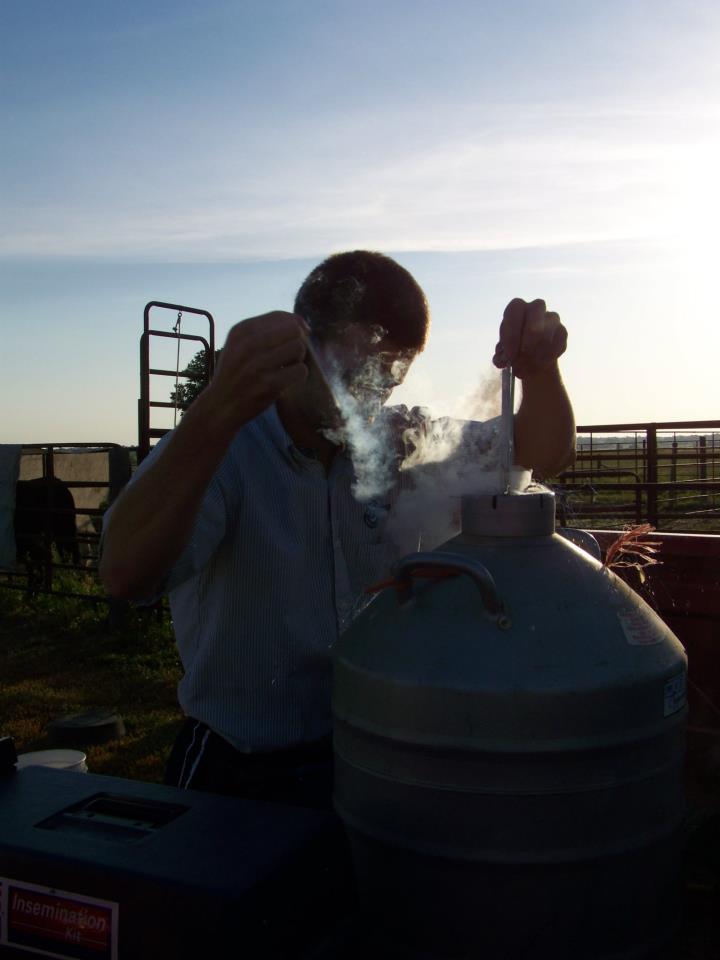
At his own operation, Wallis applies artificial insemination (AI) techniques to be more efficient and better utilize his resources. Using AI with high quality genetics and a clean up bull with good progeny makes more sense to Wallis on his small herd operation, especially when trying to build a foundation for quality registered Brangus cattle.

“AI is my best option because it gives me more flexibility,” Wallis said, “and as commercial producers are becoming more educated, seedstock producers need to be on the forefront of implementing technologies in order to meet their customers’ growing needs if they ever want to grow their market.”

Together, these technologies work to make Wallis’ operation more efficient and help reduce input costs, which has been a growing concern, especially during the relentless drought that has swept the nation the last two years.

“I would like to think that we’re talking about moderation of cow size, maybe moderation of milk production to reduce input costs,” Wallis said. “I feel like the Brangus cow will always be valuable to the industry, but at some point it will come down to reducing input costs.”


Wallis said at his operation he places emphasis on his customers’ needs and strives to provide them with the most data and information possible when making purchasing decisions. As commercial producers begin to cautiously rebuild, Wallis believes they will be more selective and will pay closer attention to genetics, and Brangus producers will have a great opportunity to supply their needs if they have the data their customers will be seeking.

“It will be important for seedstock producers to convey the genetic value and pedigree to commercial producers,” Wallis said, “and because commercial producers will be conservatively growing cow herd size, they will be more interested in the background and quality of the product they’ll be receiving.”

A recent technology, perhaps more useful as a marketing tool, has the industry buzzing. Every day more and more people are realizing the value of online communication and are experimenting with social media as a means to market a product to a larger, more diverse audience. Wallis says he realizes the benefits of using social media and has seen studies that prove more people, especially in the older generations, are using it more than what he initially perceived. One of the greatest advantages of social media, he said, is the ability to reach a mass audience very quickly while building a brand and developing trust when establishing relationships.

“To be successful, it takes balancing old techniques while implementing new technologies,” Wallis said. “By the time printed publications reach your mailbox, they are already last week’s news to the people receiving the same publications electronically, which can be detrimental to producers making business decisions based upon these materials.”


Print media is becoming less common and the public is relying on online sources for information and news. As the public becomes more disconnected with agriculture, it is becoming increasingly more important for agriculturalists to utilize the resources available to educate consumers about the industry. The (delete) cattle exposure Wallis had when he was young was enough to spark his interest in learning more about the industry that eventually led him to his career choice. Now Wallis has some suggestions on how to combat a growing obstacle threatening the future of the agriculture industry.

“I believe that we, as agriculturalists, must take an interest in young people and get them onto our farms and ranches to observe what we do on a daily basis,” Wallis said. “As a science and natural resources based field, we can easily tie our operations into valuable lesson plans.”

Speaking from experience, Wallis thinks even the most minimal exposure will be enough to pique the interest of a student and encourage them to seek a career in agriculture.

“A solution to get younger producers into agriculture is not going to present itself in a way that masses of young people will enter agricultural industries,” Wallis said. “Rather, it is going to be the one or two youngsters that were impacted by agriculture or someone in agriculture in such a way that they develop a passion for an industry, much like I have with the beef industry.”


Thank you Brittni for another great feature!! We wish Brody much success in the future, keep up the great work! You can read more stories about International Brangus Breeders Association members on their blog, and check out their Facebook page.

Wednesday, September 26, 2012

A World of Color with Sun Valley Flowers


Today we share a story from a different side of agriculture - flowers. If you have ever wondered how flowers are grown or what a flower farm is like, Sun Valley Group shares their story for you. 

Here at the Sun Valley Group our goal is to “Create a World of Color”, and how better to do that than with flowers?  We are one of the largest growers of cut flowers in the United States.  We have 3 farms in California as well as a small farm in Ontario, Canada, just north of Buffalo, N.Y.  Our headquarters is in the seaside village of Arcata, California in extreme northern California nestled between the legendary giant redwoods and the roaring Pacific Ocean.  It is at this location we hybridized the famous Stargazer Lily which became the most popular Oriental lily in the world. 


The driving force behind Sun Valley is longtime President and CEO, Lane DeVries. Lane emigrated from Holland to America in 1983 and has been the hands on leader of Sun Valley ever since. His passion for growing tulips, lilies and irises has led Sun Valley to become an industry leader. We now ship our flowers every day of the year to all 50 states, and beyond.

Life on the flower farm is similar to most other farms, you start early and it is hard work.  Crews are out picking in the huge greenhouses, hoop houses or fields at the crack of dawn.  The flowers are then graded, bundled and shipped to clients; some as big as Safeway and Kroger Supermarkets and others as small as your neighborhood florist.  We have to be constantly planning ahead.  If we need a large crop of lilies for Valentine’s Day, then we must consider this months in advance.  Taking soil nutrients, weather patterns, and sunlight ratios into account, we decide exactly what the flowers need, and there is no room for error.  Managing the day to day ebb and flow of flowers is certainly a challenge.  Besides our three main crops of tulips, lilies and irises, we grow a wide selection of other flowers and bouquet items, such as hydrangeas, brassica (ornamental kale), freesia, gerbera daisies, asters, cotinus and rosehips just to name a few.  We pride ourselves on offering our customers a large year round selection of flowers, greens and bouquets.

Picking lilies

Flowers are a very perishable product, so we have had to innovate the best ways to keep flowers fresh for the end users.  Picking them at just the right time, maintaining the Cold Chain (constant temperature control starting the moment the flower is picked) and using the most efficient forms of transportation, all ensure that the flower in a vase on your dining room table is the absolute freshest.   Seven days a week at least two trucks leave our Farm, one drives 5 hours south to San Francisco International Airport, where pallets of flowers are flown to points east.  The second truck drives straight to Oxnard CA, about 12 hours south, where the flowers are dispersed through other flower trucking lines.  The logistics are jaw dropping and at the busy times, such as Mother’s Day, we have trucks leaving constantly, crews working 24 hours a day and hundreds of thousands of stems being shipped.

Sun Valley is also strongly committed to being environmentally and socially responsible.  We have been certified by Veriflora, which represents compliance in numerous areas, including environmental sustainability, ecosystem management and protection, resource conservation, energy efficiency and integrated waste management.   This certification process was not an easy thing to do; however, we now sell our flowers with full confidence that we aren’t harming the earth in producing our spectacular blooms. 

The flower grading line

We really love flowers here on the farm, and especially flowers grown in the United States.  In the last decade or two, we have seen a dramatic shift in the cut flower industry.  Not long ago, 80% of all the cut flowers sold in the USA were grown in the USA, unfortunately, today only 20% of the flowers you see for sale at the supermarket, at florists or online are grown in the USA.  This huge swing has affected flower farming families and communities across our nation.  Today, South American grown flowers are in all segments of the market, yet, they don’t have the overall quality or environmental standards which American farmers uphold.  We are strong advocates to educate consumers and flower professionals to insist on American grown flowers, even if they aren’t from Sun Valley. 

The best part of the flower business is the farm and the people. 
Standing out in a fiery field of blooming crocosmia. 
Watching with wonder as Lane DeVries yanks an iris bulb from the ground, pulls out his pocket knife, slices the bulb open and explains what is going on with the bulb.  
Standing alone in a quiet, yet vast sea of 4 foot tall Oriental lilies in the greenhouse. 
Walking through a giant shade house of blooming hydrangea. 
Watching everyday as the tulips get bigger and bigger, reaching for the sun. 
Seeing the upbeat crews blasting music as they box up hundreds of flowers to ship out to the world. 

CEO Lane with Tulip

We are lucky enough to see these vignettes every day.  What we don’t see as often, but we know deep down in our hearts, is that we share in the joy that someone receives when they give flowers.  When the delivery man knocks on the door and there is a stunning bouquet, just for you.  Or the amazing bouquet a bride carries to the altar or the peace a bunch of lilies can bring a person as they sit in their office or home.  It is truly intangible. This is why we do it.

Be sure to follow our blog: Flower Talk and like us on Facebook to see more photos and flowers.

Thanks to Bill Prescott and Sun Valley for sharing their story about a unique and different side of agriculture. Be sure to like their facebook page and check out their blog for more information. If you or someone you know is a farmer, ag business owner, or has a passion for plants or animals - we need your story - contact us today!

Friday, September 21, 2012

Courtney Nolz - Ranch Girl and Fashionista!

Today we meet Courtney Nolz. This ranch girl has taken lessons of hard work and resilience from ranch life and applied them to starting her own business Cowgirl Crush!

I grew up in Mitchell, South Dakota. At a young age I was involved and stayed busy by being a part of 4H, the National FFA Organization and playing sports. However, my main passion growing up was raising and showing purebred Limousin cattle from my family’s ranch, Nolz Limousin. After graduating from high school, I became a Jackrabbit at South Dakota State University (SDSU) in Brookings, South Dakota to study Entrepreneurial Studies.


When I was a little girl, I would put on my Sunday dresses, put on my little cowgirl boots and absolutely beg my parents to let me go outside to chores. I am sure my parents were proud they had a daughter who wanted to be put to work, but they probably questioned my outfit choices for chore clothes. This is just one example of where my passion for agriculture and fashion come in to play. I am the proud owner of a small clothing and jewelry business. Cowgirl Crush (CCXO) was started in 2008, when I started making my own jewelry to wear to cattle shows. Soon, girls were buying the necklaces straight off my neck and I knew that this was something that I could pursue as a hobby and to make a little extra money when I was on the road.


With a love of fashion-forward trends, my jewelry designs started selling like hot cakes on Facebook after I developed the “Cowgirl Crush” page. In 2011, I added clothing and home decor to the CCXO line, and just recently added “Cowgirl Dirt” a cosmetic line to the online store www.cowgirlcrushxo.com. I plan to open a boutique when I graduate from SDSU.


I have to thank my parents for my entrepreneurial spirit. At Nolz Limousin, I grew up watching my parents sell bulls private treaty and interacting with prospective bull customers. Having my own business, I have learned a lot of sales and pricing. I pride myself by offering fashionable trends that won’t break the bank. CCXO is truly for every girl on a budget who still wants to look fabulous, without the sticker shock.


Being the middle child of three girls, I have close relationships with both of my sisters Amanda and Kaley. They are my spice in life. In the summer we would spend long afternoons washing our show calves, helping my dad in the field and working in the garden with my mom. This is something that I hold near to my heart because I learned valuable life lessons with my sisters like working hard and having a positive attitude. CCXO didn’t happen overnight and is nowhere near to where I want it to be in the future. Through good word-of-mouth, social media and a “stop-at-nothing” attitude Cowgirl Crush has gained thousands of fans on Facebook from all over the United States and a few different countries like Canada, Australia and Argentina.


Through the new CCXO website and online store cowgirlcrushxo.com, you can now fill your shopping cart from the comfort of your own home. When people shop online, if anyone is like me, I absolutely cannot wait for the mailman to show up to my door with a package for me to open. I joke with my sisters, that getting new inventory is like Christmas Day for CCXO every single time. There are the ooh’s and ah’s of showing off every new item and then instantly going to production to picture the new inventory and add it to the online store. This came from helping my parents during calving and weaning time. Seeing a newborn baby calf is an experience no one should miss out on and to see all of your hard work taking care of the calves and seeing the growth development at weaning time is rewarding and fulfilling.

Growing up on a cattle ranch in my opinion is truly a great way to live and I can definitely say that my roots in agriculture have pushed me to reach my goals today with Cowgirl Crush as well as anything else I set my mind to. A farm girl’s dream really has come true, I can wear my dress and my cowgirl boots too! After college I would not only like to have a career in agriculture, but a pasture full of cattle and house on a hill. Every farmers dream right?

So what is Cowgirl Crush?

Everyone knows that girl...the girl who is confident, who feels good in her own skin and who radiates a certain charm that draws in others like moths to a flame. Cowgirl Crush emulates that woman. And, whether you feel best in a dusty pair of cowgirl boots or a five-inch set of heels, CCXO has the style-savvy to make you look and feel your best in every occasion.

Pucker up, fellas, and get a load of this CCXO girl. She is bold, beautiful, smart and charismatic. She is unstoppable.

“I figure if a girl wants to be a legend, she should just go ahead and be one.” -- Calamity Jane


Thanks Courtney for a great feature and good luck in your future endeavors - we wish you much success! Be sure to check out Cowgirl Crush on Facebook and on their new website!

Are you a beginning farmer? Budding ag businessperson? You could be the next FOA feature! Contact us today - You will be glad you did!

Wednesday, September 19, 2012

Jennifer and Travis - Nevada Ranching Family

Please welcome Jennifer and Travis to Faces of Agriculture. This Nevada ranch family is proud to be involved in agriculture and bring food to your table. (photo credits to Heidi Stevens.)

Hello, my name is Jennifer. My husband Travis, our 2 boys and I live on a ranch in the beautiful Ruby Mountains near Lamoille, Nevada. It is said that “Behind every successful cowboy is a wife with a good job in town!” We are no exception. Like many ranch wives, I have a job in town. I tried teaching High School Agriculture for a couple of years, but learned that I was better suited to older students and now teach Animal Science at Great Basin College in Elko, Nevada. I have a bachelor’s of Science in Agriculture Education from Montana State University.


I work alongside Travis for Maggie Creek Ranches. Travis is the foreman here on the Lamoille division. We take care of beef pairs but primarily run yearlings from May to October. Lamoille is arguably one of the prettiest places in Nevada and we are so blessed to live where we do. We have an apple orchard in our back yard and the gorgeous Ruby Mountains in our front yard. There is plenty of room for our boys to run and grow.

One of the best things about our job here is that Maggie Creek is a family ranch and we get to take our boys to work with us whenever we want to. This is very important to my husband and me. We both grew up on ranches working with our families. It is not uncommon to drive past one of our fields and see me leading one horse with one son and riding with a kid in front of me, or see my boys helping us rebuild fence, playing in a supplement trough while Travis and I doctor a yearling nearby. Most parents buy expensive playground equipment for their kids, we have trees to climb, antique farm equipment and miles of pasture for ours to play.


Maggie Creek is a cattle operation. We run cattle on range that isn’t adequate for any other type of crop, or suitable for living. It gives us a sense of pride to know that we are taking sunshine and grasses that are indigestible to humans and creating a healthy delicious food for people. We are committed to producing a safe and wholesome product for the world.

My parents ranch near Mountain City, Nevada. My great grandparents originally purchased the ranch in the 1930’s, and our family haslived on this ranch ever since. My great granddad brought the first Black Angus cows to Northeastern Nevada. They have run strictly Black Angus since then; my dad has worked really hard to make it one of the best herds in the state. I hope to one day go home to Mountain City to ranch, making my boys 5th generation ranchers in the area.


Travis and I come by ranching very naturally as you can tell. We have started our own herd of black cows and look forward to teaching our boys where their food comes from and the same lessons of hard work, determination, and perseverance our parents have taught us.

I love all aspects of raising cattle. I remember being 4 years old and my mom gathering up my little sister and me in the middle of the night to help my dad pull our first calf out of a Registered Angus cow our parents bought for us from Thomas Angus, making calving and winter one of my favorite times of the year. There is nothing cuter to me than watching a baby calf switching its tail as it nurses. I also love spring and branding. Then in the summer comes a lot of saddle time as we doctor yearlings and check on calves. Fall with the weather turning cooler comes shipping time- that bittersweet time of the year when we sell our calves and we can see what all our hard work was for.


We do this because we love this way of life and the livestock, and it gives us great satisfaction to know that maybe we made a difference somewhere. Maybe it was for the calf we saved from the creek, or the person who buys one of our steaks, but a difference none the less, and we enjoy our job!I always tell Travis a bad day cowboying beats a good day teaching!

Thank you Jennifer for the great feature and for sharing your story with us! You can keep up with this ranching family with her blog Ramblings from a Ranch Wife

If you would like to be the next Faces of Agriculture Feature - Contact us! We need your story today!

Monday, September 17, 2012

Austin Black - Missouri Cattle Producer

Today we meet Austin Black - a photojournalist and 4th generation cattle producer from Missouri!

Hi, my name is Austin Black and I'm from Central Missouri. My family owns a small cow/calf operation in the West Central part of the state and my mom operates a freelance writing and speaking business out of her home while my dad pastors at a small country church and works construction full time. Although I'm not actively involved with the home operation these days, I work as photojournalist for MFA Incorporated, the regions largest feed & farm supply company.


Growing up, I was extremely active in 4-H showing cattle, horses, hogs, and even sheep for a few years. Being involved in this realm strengthened my love for agriculture tremendously. As a 4th generation cattle producer, I was nurtured and developed to love the lifestyle that raising cattle created. Caring for the livestock, seeing the baby calves grow, making breeding, management and purchasing decisions, and sharing the life with family is what makes being a cattle producer something I cherish.


But being a cattle producer isn't always a fun and enjoyable job. Our farm is located over an hour away and my dad tries to check on stuff 2-3 times a week. Fortunately, he works in that area on a somewhat regular basis, so it makes it a little easier. But it's quite honestly a chore and an expense to make the drive and care for our livestock. To say the least, doing general maintenance, herd management, and monitoring the farm is typically an all day ordeal no matter how much actually get done. During the drought, we were watering our fall calving herd and some young heifers out of two stock tanks that needed refilling about every other day. But it never matters how far of a drive, how expensive the fuel, or how tired we are, the cattle require our care and it's our responsibility and our duty to provide the best care possible.


One thing I wish people understood about livestock operations is the fact that farms and ranches have to operate as a business these days for people to have a livelihood running them. Too many consumers believe that if a farm is run “efficiently” to “make a profit”, they must be providing less than adequate care for their livestock. It saddens me that every other industry in the world is praised for making advancements in technology, becoming more efficient, and ensuring environmental stability but agriculture is accused of getting too big and too industrial. I'm afraid consumers don't realize the magnitude of demand that US agriculture is required to meet through its production. This production demands efficiency and quantity, but never loses sight of quality. Every family farm that comprises the 98% of agriculture enterprises in the US is dedicated to raising and producing the safest, healthiest, more affordable food available.


I'm Austin Black, and I'm proud to be the Face of Ag!

Thank you Austin for a great feature! You can follow Austin on his blog Off the Beaten Path. Austin also has a freelance video and photography business - you can find it on Facebook by clicking on this link and visit his webpage!  

Don't forget - YOU can be the next Face of Agriculture Feature - Contact us today!!!! 

Friday, September 14, 2012

Farmer Bright's Dairy

Today we welcome Ryan Bright, a.k.a. "Farmer Bright" as he shares with us his story of how he came to work full time on a dairy farm alongside his father and un

When people ask me how long I've been farming I always have a hard time answering them. I've been a full time dairy farmer since I graduated the University of Tennessee with a degree in Animal Science, but my mom would tell you that my first word was "tractor." I guess you could say farming is in my blood.


I am part of the 5th generation to live and work on our Tennessee dairy farm. My earliest memories are going with my father to the farm. Every summer I had two baby calves to raise that I was responsible for. While I might have terrorized some innocent farm cats, I had plenty of chores to keep me busy growing up. I think the lessons I learned through hard work and responsibility as a child greatly influenced the values I hold now. 


Today we milk around 100 Holstein dairy cows. My day begins before the sun comes up when the first thing I do is to bring the cows in from the field. While those are being milked I feed our dry cows (that is the pregnant cows) and all of our calves. After that I help finish milking in the milk barn and finally eat breakfast! And you are right if you think milk is the centerpiece of my meal! The middle part of the day is spent working in the fields or fixing things until it is time to feed and milk again.


We raise wheat, rye, and rye grass, in the winter for silage that we store in upright silos. In the summer we plant corn, pearl millet, and sudan sorghum for silage. We also bale as much hay as we can. Everything we harvest is for the cows. 


I work on the farm alongside my father and uncle. They have been full time farming since their father passed away while they were in their teens. My grandmother was the biggest advocate for agriculture in my life before I even recognized what she was doing. I knew she was very proud of our farm that her parents and grandparents had begun. My first bit of agvocacy was being in part of a slide show on our farm she made to bring the Agriculture in the Classroom project to Tennessee. She instilled in me the belief that farmers need to share their story with consumers. I've often wondered what she would think of how farmers use social media to speak to others if she were still alive today and how she might use it.


I am on Twitter @farmerbright and I also write two blogs. The Udder Side is told from the tongue-in-cheek perspective of the cows on our dairy reporting on The Farmer. Silo Skies is a more straight forward blog that I use to share what we're doing on the farm and other agriculture issues.

Thanks for sharing your story Ryan! It take dedicated and hard working people like Ryan to provide food to feed America each day. Remember - if you or someone you know would like to be featured as a Face of Agriculture, please contact us! We need your story!

Wednesday, September 12, 2012

Amanda Radke - Agvocate and Cattle Rancher

Today we are proud to feature Amanda Radke from South Dakota. Amanda is an active voice for agriculture - writing for several beef industry publications.

Howdy from my family ranch located near Mitchell, SD. My husband, Tyler, and I, live in the corner of Davison County. We are the only house in the section (No neighbors! Although my parents live on the next section just a half-mile away); we are the last house on the electrical pole, so when the electricity goes out, it stays out for awhile; we are 20 miles from the closest internet tower, which means I have bad service, making it difficult as I blog from home; and, when it snows, we are the last house to get plowed out. We’ve spent 11 days snowed in with no electricity -- talk about living like Laura Ingalls Wilder!


I’m a fifth generation cattle rancher -- the third to live and work on our ranch. My family raises purebred Limousin cattle. NOLZ Limousin offers bulls and females for sale by private treaty. www.nolzlimousin.com. We also raise corn, sedan grass and hay -- both round and squares. One of the first investments my husband and I made in our first year of marriage was a square baler; Tyler drives, and I ride the rack. Thousands of “idiot cubes” later, we still enjoy working together (although sometimes I wish it was him on the rack, not me!) We both have off-farm jobs for cash-flow purposes. Tyler works at Lynch Livestock as a hog buyer, and I’m a freelance writer for several beef industry publications. You can read my blog at www.beefmagazine.com.


Shortly after we got married, we purchased our dream place, which bumps right up to my parents’ pasture and has beautiful, well-maintained cattle facilities and the perfect pasture for our replacement heifers. This was a huge purchase to make at age 23, so we have buckled down in our spending and have focused on paying off that debt and saving for cattle down the road. But, we know what our goals are, so it doesn’t seem like much of a sacrifice. We are doing this together, and we love it.

We both have deep roots in the cattle business and want to be able to continue this tradition to the next generation. We are very passionate about the land and quality livestock, and it’s something we sit around the dinner table -- eating homegrown beef and my garden-fresh vegetables and fruits -- discussing.

A typical day for me: Wake up and do chores, tinker around the garden, take a walk or run around the section with our dog Allie, and head to the house and settle down with my laptop tackling deadlines and submitting my blogs, columns and articles as required by my editors. I take breaks or adjust my writing schedule as needed with cattle chores outside. On days I know we will be busy weaning, working cattle or baling hay, I write late into the evenings or have long all-day sessions in preparation to be outside all day. I have a smartphone, too, which enables me to work on the go. I take great pride in cooking healthy meals for my family, and I make an effort to get Tyler and I to sit down and eat together in the evenings. This is no small task, as we are usually busy outside working. Tyler gets home from work around 3, and that’s when his second job starts -- taking care of cattle, fixing things (he is our resident mechanic) and doing other chores as needed. My dad had three daughters, so he welcomes a son with open arms. It’s great to see them work together.


Our days end on our back deck. Tyler and I love to watch the sun go down on our pasture. Cattle graze on the rolling hills. It’s a beautiful sight that can reduce me to tears. I just feel so incredibly blessed to live where I do and work at a job that I love. The peace and serenity country living offers us is truly rare in today’s society, and we wouldn’t trade it for all the gold in the world.

I have traveled all over the country as a speaker at many agriculture conferences, and in my travels, I meet many consumers who don’t necessarily understand what we do. I’ve been called a murderer. I’ve been likened to Hitler, killing steers just as the Nazis killed the Jews. I have been called heartless. I have been accused of not caring about the animals. Not only are these statements hurtful, but they are so off-based. Cattle are my life. It’s hard to make a buck in the beef business; in fact, many years we are in the red. I wish consumers understood the blood, sweat and tears that goes into this business and know that we aren’t in it out of greed (trust me, there are easier ways to make a dollar); we are in it because we truly love the land, the animals and this way of life.

In 2011, I published a children’s book, “Levi’s Lost Calf,” which helps tell the beef production story to young people. I welcome the opportunity to visit schools and libraries to read my book and visit with kids about who we are in animal agriculture.


I’m a country girl. Plain and simple. But, I love connecting with urban folks in my travels. Although sometimes I feel like we are world’s apart -- we have a lot in common, too. We can talk fashion, food (I love SUSHI!), families, working out, college, goals for the future, etc. It’s in these commonalities where we can make connections and bridge the gap between rural and urban America. As a writer, that’s what I try to do. As a rancher, I know it’s what we need to do. And, as a consumer myself, it’s what I hope to hear from other farmers and ranchers as I go grocery shopping.

Thanks Amanda for sharing your story and for all that you do!! Be sure to follow her on the Beef Magazine Blog!

You can be the next Face of Agriculture Feature! - Contact us today! We need to hear from agriculturists in all walks of life!