Showing posts with label 4-H. Show all posts

Friday, September 28, 2012

Brody Wallis - Oklahoma Brangus Producer

Today we are happy to have a feature brought to us by Brittni Drennan, Communications Coordinator for the International Brangus Breeders Association. Oklahoma producer Brody Wallis is using new technologies and old techniques to ensure success!

Most involved in the cattle industry are aware of a potential threat that began creeping up in the minds of producers across the nation and is gaining speed as it quickly approaches. The question lingering among farmers and producers is, “Who is going to lead the future of agriculture”?


While many producers are ready to hand down the reins of their operations, there are fewer young people willing to take over. However, that does not mean there are not still some out there willing to jump in and give it a try.

Brody Wallis grew up in Atoka found in southeastern Oklahoma and was always drawn to the agriculture industry. He was raised on his family’s small ranch in which a commercial cow-calf operation was in place to manage the property as well as keep family ties to the cattle industry. He then began taking more of an interest in the cattle operation as he was exposed to agriculture through 4-H and showing cattle throughout high school in FFA. He especially enjoyed visiting relatives on larger cattle operations in north Texas where he was able to watch and learn how large-scale commercial cattle ranches operated.


Wallis started college at Oklahoma State University with the intent of practicing large animal veterinary medicine. He later decided that he wanted to be in the beef industry in another capacity. He changed his Animal Science option from pre-vet to business and began taking classes in economics and range management to gain knowledge that would prepare him for a future in the cattle industry. His formal education helped Wallis form the basis for a small herd of cows on his family ranch.

“As a long-term goal, I want to be a producer who can make a positive impact in the industry,” Wallis said. “With an aging industry and aging producers, there are going to be more opportunities for young producers to introduce new ideas and perspectives to advance and grow the industry all while maintaining the values and beliefs that leaders ahead of us instilled.”

Wallis grew up around commercial cow-calf operations, but when he went to college one of his goal was to diversify himself within the beef industry. He worked for the OSU purebred cattle operation while obtaining his bachelor’s degree as well as worked for a year in the OSU meat laboratory on the campus in Stillwater. To gain valuable experience in the cattle feeding industry he worked as an intern for JBS Five Rivers Cattle Feeding LLC in Hartley, Texas. Wallis is now about to complete his master’s degree at OSU in animal science specializing in ruminant nutrition while doing his research in grazing stocker cattle and subsequent feedyard performance.


“As young people in the industry, we can bring advanced technologies and higher education back to introduce to the operation,” Wallis said. “And with my background and the mentors I’ve had, I want to provide quality genetics to commercial producers whether it’s Brangus bulls and females or crossbred females.”

Wallis bought his first registered Brangus cows a few years ago and now has a small herd on which to build a good, solid foundation of quality genetics. He said his fascination with the breed began at an early age, and as he began to learn more about the industry, he realized the true value of Brangus cattle. Combining the most desirable traits from both Bos Indicus and Continental breeds, Brangus cattle are most well known for their ability to adapt to a variety of climates and the harshest environments. From personal experience, Wallis said he credits them for their mothering ability, longevity and parasite resistance. Brangus cattle also maintain good efficiency in the feedyard and high cutability with the ability to meet Certified Angus Beef (CAB) qualification standards.

Wallis attributes Tinker Ray, also from Atoka, for guidance and assistance in getting started. Upon graduating from OSU, Ray and his brothers built their Brangus program, Ray Brothers Brangus, and introduced new blood lines into the breed. Wallis said Ray was a big proponent of gain tests and helped establish OSU’s bull test station. Operating since 1973, Oklahoma Beef, Inc. is now the second largest test station in the U.S.

Influenced by Ray, his professors and the research he conducted in graduate school, Wallis focuses on performance data and believes EPDs are beneficial in making breeding selections and assist in making purchasing decisions, but he stresses that selecting animals based upon EPDs requires in-depth research on how each EPD will influence a particular herd rather than simply selecting high numbered bulls. He supports breed associations in advancing work to develop genomically enhanced EPDs that will allow producers to select economically important traits based on proven data. Wallis said he believes, as a seedstock producer, his role is to record accurate numbers that improve the breed and maintain the integrity of the breed association.

“You can’t deny their value based on hard data that have proven these numbers as well as developed other genetic selection measurements and indexes beyond simple measures of birth weight and weaning weight, for example,” Wallis said. “The industry outside of your own backyard is progressing so quickly and more customers are realizing the value of these technologies.”

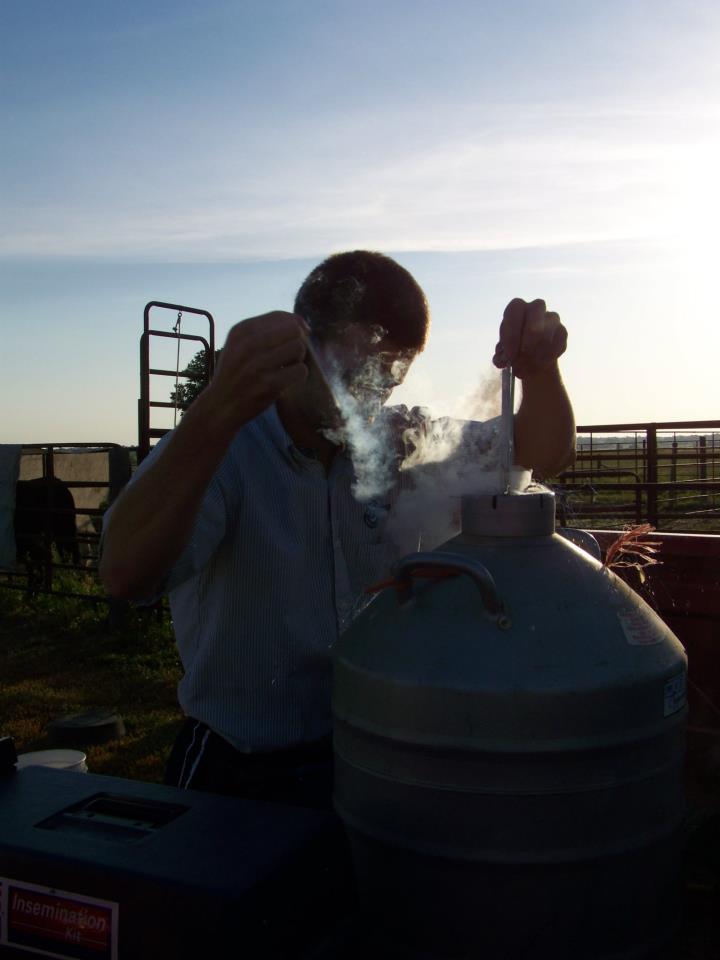
At his own operation, Wallis applies artificial insemination (AI) techniques to be more efficient and better utilize his resources. Using AI with high quality genetics and a clean up bull with good progeny makes more sense to Wallis on his small herd operation, especially when trying to build a foundation for quality registered Brangus cattle.

“AI is my best option because it gives me more flexibility,” Wallis said, “and as commercial producers are becoming more educated, seedstock producers need to be on the forefront of implementing technologies in order to meet their customers’ growing needs if they ever want to grow their market.”

Together, these technologies work to make Wallis’ operation more efficient and help reduce input costs, which has been a growing concern, especially during the relentless drought that has swept the nation the last two years.

“I would like to think that we’re talking about moderation of cow size, maybe moderation of milk production to reduce input costs,” Wallis said. “I feel like the Brangus cow will always be valuable to the industry, but at some point it will come down to reducing input costs.”


Wallis said at his operation he places emphasis on his customers’ needs and strives to provide them with the most data and information possible when making purchasing decisions. As commercial producers begin to cautiously rebuild, Wallis believes they will be more selective and will pay closer attention to genetics, and Brangus producers will have a great opportunity to supply their needs if they have the data their customers will be seeking.

“It will be important for seedstock producers to convey the genetic value and pedigree to commercial producers,” Wallis said, “and because commercial producers will be conservatively growing cow herd size, they will be more interested in the background and quality of the product they’ll be receiving.”

A recent technology, perhaps more useful as a marketing tool, has the industry buzzing. Every day more and more people are realizing the value of online communication and are experimenting with social media as a means to market a product to a larger, more diverse audience. Wallis says he realizes the benefits of using social media and has seen studies that prove more people, especially in the older generations, are using it more than what he initially perceived. One of the greatest advantages of social media, he said, is the ability to reach a mass audience very quickly while building a brand and developing trust when establishing relationships.

“To be successful, it takes balancing old techniques while implementing new technologies,” Wallis said. “By the time printed publications reach your mailbox, they are already last week’s news to the people receiving the same publications electronically, which can be detrimental to producers making business decisions based upon these materials.”


Print media is becoming less common and the public is relying on online sources for information and news. As the public becomes more disconnected with agriculture, it is becoming increasingly more important for agriculturalists to utilize the resources available to educate consumers about the industry. The (delete) cattle exposure Wallis had when he was young was enough to spark his interest in learning more about the industry that eventually led him to his career choice. Now Wallis has some suggestions on how to combat a growing obstacle threatening the future of the agriculture industry.

“I believe that we, as agriculturalists, must take an interest in young people and get them onto our farms and ranches to observe what we do on a daily basis,” Wallis said. “As a science and natural resources based field, we can easily tie our operations into valuable lesson plans.”

Speaking from experience, Wallis thinks even the most minimal exposure will be enough to pique the interest of a student and encourage them to seek a career in agriculture.

“A solution to get younger producers into agriculture is not going to present itself in a way that masses of young people will enter agricultural industries,” Wallis said. “Rather, it is going to be the one or two youngsters that were impacted by agriculture or someone in agriculture in such a way that they develop a passion for an industry, much like I have with the beef industry.”


Thank you Brittni for another great feature!! We wish Brody much success in the future, keep up the great work! You can read more stories about International Brangus Breeders Association members on their blog, and check out their Facebook page.

Friday, September 21, 2012

Courtney Nolz - Ranch Girl and Fashionista!

Today we meet Courtney Nolz. This ranch girl has taken lessons of hard work and resilience from ranch life and applied them to starting her own business Cowgirl Crush!

I grew up in Mitchell, South Dakota. At a young age I was involved and stayed busy by being a part of 4H, the National FFA Organization and playing sports. However, my main passion growing up was raising and showing purebred Limousin cattle from my family’s ranch, Nolz Limousin. After graduating from high school, I became a Jackrabbit at South Dakota State University (SDSU) in Brookings, South Dakota to study Entrepreneurial Studies.


When I was a little girl, I would put on my Sunday dresses, put on my little cowgirl boots and absolutely beg my parents to let me go outside to chores. I am sure my parents were proud they had a daughter who wanted to be put to work, but they probably questioned my outfit choices for chore clothes. This is just one example of where my passion for agriculture and fashion come in to play. I am the proud owner of a small clothing and jewelry business. Cowgirl Crush (CCXO) was started in 2008, when I started making my own jewelry to wear to cattle shows. Soon, girls were buying the necklaces straight off my neck and I knew that this was something that I could pursue as a hobby and to make a little extra money when I was on the road.


With a love of fashion-forward trends, my jewelry designs started selling like hot cakes on Facebook after I developed the “Cowgirl Crush” page. In 2011, I added clothing and home decor to the CCXO line, and just recently added “Cowgirl Dirt” a cosmetic line to the online store www.cowgirlcrushxo.com. I plan to open a boutique when I graduate from SDSU.


I have to thank my parents for my entrepreneurial spirit. At Nolz Limousin, I grew up watching my parents sell bulls private treaty and interacting with prospective bull customers. Having my own business, I have learned a lot of sales and pricing. I pride myself by offering fashionable trends that won’t break the bank. CCXO is truly for every girl on a budget who still wants to look fabulous, without the sticker shock.


Being the middle child of three girls, I have close relationships with both of my sisters Amanda and Kaley. They are my spice in life. In the summer we would spend long afternoons washing our show calves, helping my dad in the field and working in the garden with my mom. This is something that I hold near to my heart because I learned valuable life lessons with my sisters like working hard and having a positive attitude. CCXO didn’t happen overnight and is nowhere near to where I want it to be in the future. Through good word-of-mouth, social media and a “stop-at-nothing” attitude Cowgirl Crush has gained thousands of fans on Facebook from all over the United States and a few different countries like Canada, Australia and Argentina.


Through the new CCXO website and online store cowgirlcrushxo.com, you can now fill your shopping cart from the comfort of your own home. When people shop online, if anyone is like me, I absolutely cannot wait for the mailman to show up to my door with a package for me to open. I joke with my sisters, that getting new inventory is like Christmas Day for CCXO every single time. There are the ooh’s and ah’s of showing off every new item and then instantly going to production to picture the new inventory and add it to the online store. This came from helping my parents during calving and weaning time. Seeing a newborn baby calf is an experience no one should miss out on and to see all of your hard work taking care of the calves and seeing the growth development at weaning time is rewarding and fulfilling.

Growing up on a cattle ranch in my opinion is truly a great way to live and I can definitely say that my roots in agriculture have pushed me to reach my goals today with Cowgirl Crush as well as anything else I set my mind to. A farm girl’s dream really has come true, I can wear my dress and my cowgirl boots too! After college I would not only like to have a career in agriculture, but a pasture full of cattle and house on a hill. Every farmers dream right?

So what is Cowgirl Crush?

Everyone knows that girl...the girl who is confident, who feels good in her own skin and who radiates a certain charm that draws in others like moths to a flame. Cowgirl Crush emulates that woman. And, whether you feel best in a dusty pair of cowgirl boots or a five-inch set of heels, CCXO has the style-savvy to make you look and feel your best in every occasion.

Pucker up, fellas, and get a load of this CCXO girl. She is bold, beautiful, smart and charismatic. She is unstoppable.

“I figure if a girl wants to be a legend, she should just go ahead and be one.” -- Calamity Jane


Thanks Courtney for a great feature and good luck in your future endeavors - we wish you much success! Be sure to check out Cowgirl Crush on Facebook and on their new website!

Are you a beginning farmer? Budding ag businessperson? You could be the next FOA feature! Contact us today - You will be glad you did!

Monday, September 17, 2012

Austin Black - Missouri Cattle Producer

Today we meet Austin Black - a photojournalist and 4th generation cattle producer from Missouri!

Hi, my name is Austin Black and I'm from Central Missouri. My family owns a small cow/calf operation in the West Central part of the state and my mom operates a freelance writing and speaking business out of her home while my dad pastors at a small country church and works construction full time. Although I'm not actively involved with the home operation these days, I work as photojournalist for MFA Incorporated, the regions largest feed & farm supply company.


Growing up, I was extremely active in 4-H showing cattle, horses, hogs, and even sheep for a few years. Being involved in this realm strengthened my love for agriculture tremendously. As a 4th generation cattle producer, I was nurtured and developed to love the lifestyle that raising cattle created. Caring for the livestock, seeing the baby calves grow, making breeding, management and purchasing decisions, and sharing the life with family is what makes being a cattle producer something I cherish.


But being a cattle producer isn't always a fun and enjoyable job. Our farm is located over an hour away and my dad tries to check on stuff 2-3 times a week. Fortunately, he works in that area on a somewhat regular basis, so it makes it a little easier. But it's quite honestly a chore and an expense to make the drive and care for our livestock. To say the least, doing general maintenance, herd management, and monitoring the farm is typically an all day ordeal no matter how much actually get done. During the drought, we were watering our fall calving herd and some young heifers out of two stock tanks that needed refilling about every other day. But it never matters how far of a drive, how expensive the fuel, or how tired we are, the cattle require our care and it's our responsibility and our duty to provide the best care possible.


One thing I wish people understood about livestock operations is the fact that farms and ranches have to operate as a business these days for people to have a livelihood running them. Too many consumers believe that if a farm is run “efficiently” to “make a profit”, they must be providing less than adequate care for their livestock. It saddens me that every other industry in the world is praised for making advancements in technology, becoming more efficient, and ensuring environmental stability but agriculture is accused of getting too big and too industrial. I'm afraid consumers don't realize the magnitude of demand that US agriculture is required to meet through its production. This production demands efficiency and quantity, but never loses sight of quality. Every family farm that comprises the 98% of agriculture enterprises in the US is dedicated to raising and producing the safest, healthiest, more affordable food available.


I'm Austin Black, and I'm proud to be the Face of Ag!

Thank you Austin for a great feature! You can follow Austin on his blog Off the Beaten Path. Austin also has a freelance video and photography business - you can find it on Facebook by clicking on this link and visit his webpage!  

Don't forget - YOU can be the next Face of Agriculture Feature - Contact us today!!!! 

Wednesday, September 5, 2012

Tales from a Kansas Farm Mom

Today we welcome Nicole Small from Kansas! She is passionate about farming and teaching the next generation about where their food comes from!

Hi my name is Nicole Small. My husband, Randy, and I farm together in Southeast Kansas. We are both the 5thgeneration from each of our families to farm in the same county in Kansas as our ancestors. I work full time on the farm with my husband. My father-in-law retired in 2007, but still likes to come see where he can help out. My parents and mother-in-law help on the farm when they are needed. They help the most with the care of our two wonderful boys and are great taxi drivers when we need to move equipment or we need a ride home at night.


Our farm is unique in that both my husband and I have college degrees and we both work on the farm together full time. I tend to take care of the cattle decisions and management and he helps me when things are slower in the crop fields. He makes all of the cropping decisions and puts up with a lot of irritating questions from me about why we do things the way we do. I am a think outside the box kind of girl and sometimes that doesn’t go over so well.

We have a commercial cow/calf operation. Most of the cows calve in February and March, but we do have a small herd that calves in the Fall. In the Summer and Fall when the cattle can find the nutrition they need from their grass, I help with the crop farming. I help haul fertilizer and water to the sprayer, run the combine during harvest, do lots of errands and do most of the paperwork. Randy helps me out during calving and processing time.


Our goal is to care for the land and resources that we have been given and leave them better than when we started. We have been 100% no-till for the last 14 years. We are constantly implementing new farming techniques and using science to make the right decisions. We have over 20 landowners that trust us to make the right decisions for their farms. In addition, we have two young sons that may want to come back to the farm some day and we want it to be in the best conditions possible if they choose to come back. Caring for the resources that have been given to us can be a huge burden, but incredibly rewarding at the same time.


We have 2 boys that like to help us out on the farm. Each year they are in charge of any bottle calves we may have and do a great job with the chores. Next year, they will both be in 4-H and I can’t wait to see them grow and learn about new things each year. Here is our oldest son showing his registered Limousin heifer at the county fair this summer.


I love to volunteer with kids especially in 4-H. Every year it seems that I have earned a new son or daughter from the support and guidance I have given them. These kids are the future of America and I feel a responsibility to help them achieve their goals. There were many people who supported and guided me in my youth and I feel it is my responsibility to help these young people like I once was supported.

I also enjoy going into classrooms to teach kids about agriculture and being a Farm Mom to the Kindergarten and Pre-K kids. We live in a small rural town. It amazes me how few of the kids have any ties to agriculture and how little they know about where their food comes from. I hope that I can teach them at least one thing about agriculture that sticks with them and that they can go home and tell their parents.


We grow corn, wheat, soybeans and grasses for hay on our farm. Here is a picture of Randy planting soybeans this spring after he spent the afternoon helping with the Kindergarten field day for the local school. Growing a variety of crops allows for crop rotations, spreads out the work load throughout the year and allows us to market crops with totally different end uses.


You can read more about our adventures in farming on my blog Tales of A Kansas Farm Mom. I post a new recipe every Wednesday that has been farm mom tested if you are looking for something new to fix for supper. You can also follow me on Facebook at A Kansas Farm Mom.

Thank you Nicole for the great feature!!! Be sure to visit her blog and Facebook page!

Calling all those aggies out there! We want to hear your story about your farm or ranch! Whats your tie to agriculture? Share your story and voice here! Contact us today!

Friday, August 31, 2012

Cody of H&K Farms

Today we welcome back Kathy of H&K Farms. Kathy has shared her story on this blog before, but is returning today to tell the story of her son and his place in agriculture as a tribute to his 18th birthday. 

Hello, this is Kathy Hasekamp of H&K Farms and I posted our story on Faces of Agriculture back in July. But I was thinking that within ‘our’ story are many stories. The story that I wanted to focus on today is our oldest son, Cody’s story. On September 5th, his 18th birthday, by the worlds’ standard he will be a man. But this young man has filled that capacity for some time now. As a little boy, it was his utter delight to ride with Dad or Grandpa in the tractor, combine, truck, or the four wheeler - you get the idea. As he grew up, he couldn’t wait to do the driving. I remember many conversations on that how he was old enough or big enough to mow the grass or take a soda to dad on the four wheeler, or whatever else he was trying to sell me on him doing at the time. 

Summer 1995 - Planting with dad at 8-months-old
Like many rural kids, when Cody turned 8, he joined 4-H, which was 10 years ago this September. He went to his first 4-H meeting which was on his 8th birthday. How appropriate that the first meeting of his last year in 4-H also falls on his birthday. Through 4-H, Cody has learned many great life skills, from working with his cattle, to welding, working on a small engine, and in later years, running the meeting as president and supervising a cabin full of campers as counselor. He’s not 100% sure what he wants to major in, in college; but 4-H has given him so many great building blocks on which to start. 

Summer 1999 - Trying out dad's pedal tractor, age 5

As Cody got older, he began helping his Dad and Grandpa on the farm. Basic beginner jobs, like raking hay, picking up square bales and evening feeding were his jobs. In the last few years, he’s driven and dumped grain trucks, did some of the planting, and helps with silage chopping. We sell seed corn and Cody always helps his dad organize the varieties and plant the test plot, which is a tedious job. Cody’s attention to detail and making sure everything is lined up as it should be are a great help to his dad. 

Summer 2003 - Showing an angus steer, age 9

In the showing of cattle, Cody is growing his herd of registered Angus cows. Out of one of his first show heifers, he raised and sold a bull. He has saved a nice nest egg towards college through the sales of his steers and other 4-H projects over the years. He has also made a wonderful network of friends through showing cattle. Of course he didn’t realize it at the time, but those kids he played and hung out with over the years will be tomorrow’s business contacts. In fact he already works with some of those kids in his hay hauling business.

As is the natural progression of things, when Cody got to high school, he joined our local FFA chapter. Through FFA, he’s broadened his skills through contest teams, meeting more friends and has been able to share his story with many more people. The chapter sells fruit each fall to raise money to attend the National Convention. In meeting and doing business with the 60 or so people he sells to, he’s had the opportunity to share parts of his day to day life with people he would have never known before, and through him, several more people see the future of agriculture in that blue corduroy jacket. Through the chapter, he’s helped at the local food bank, done yard work for the local elderly and enjoyed exhibiting at local and state fairs. 

Fall 2010 - FFA Awards, Grandpa won Chapter Hall of Fame

After he turned 16, he decided that a ‘side job’ would be a great way to have that gas money throughout the school year. During the school year, outside of chores at the farm, it’s hard for him to have a ‘job’ as he plays two sports and is active in 4-H and FFA so there is not much time left to flip burgers or whatever else he might find. So my math minded kid, sat down and figured out that if he bought an older pickup, one that he could pay cash for and just needed the basic insurance and talked Dad into making a deal on a trailer, he could start a hay hauling crew. He has the perfect pool of guys to hire from, as he plays on the football team and has a coach who is more than happy to encourage the ‘town’ guys to go and get in some conditioning in the hay field. Through his business he’s learned to keep good books and be organized with his contacts. It’s been a good life experience dealing with other people, both the farmers hiring the crew and the guys on the crew. He’s had to be flexible; he’s taught other kids how to drive a manual transmission, he’s learned to pay attention to all else going on in the community. He found out the hard way that taking a job the week of the county fair, wrestling camp and 2 a day football is going on is tough - thankfully he found enough older and younger kids to get the job done. And that not everyone is willing to kill themselves in 100 degree heat in their off hours between practices. Some life lessons learned. 

Summer 2012 - Stacking hay, age 17

Like most farm kids, Cody has many responsibilities around the farm. This summer for example, his mornings started earlier than even his dad. He went into weightlifting with the football team at 5am, 5 days a week, most of the summer. When he got back home, he worked with his dad all day, somedays he had practice or 7 on 7 league that evening, so he ‘got’ to quit early. If he wasn’t working with his dad, he was in the barn, preparing our show cattle for the fair season. The kids did most of the work in leading the calves, washing and clipping. Then there was his hay hauling, which with this year’s drought was basically done by the end of June. So some of his days started at 5am and ended well after midnight. He did get a couple of breaks this summer; we didn’t ‘work’ him all summer. He was the head counselor at 4-H camp, something that he’s went to, I believe, about every year since he joined 4-H, having been a counselor the last few years. We also exhibit at the Missouri State Fair, which we did this year as well. He did make a trip back home and catch a football practice while we were there. 


He’s a dedicated young man. I know sometimes I even forget how many irons he’s got in the fire. He keeps it all going, some days I wonder how. Helps his dad on the farm, plays sports, keeps good grades in tough classes (he is taking many dual credit classes) and still manages to get enough downtime in that he stays pretty happy and satisfied and we do too. He may not realize it, but in keeping all this going, he’s learning a strong work ethic that will take him far in this world. His dad and I will be lucky and blessed if it takes him back home to farm, but we would be thrilled to watch him conquer the world, because we are pretty sure being raised a farm kid, he could do it!

Thanks for the fantastic feature Kathy! Seeing the future of agriculture in hard working young people like Cody is an inspiration to everyone. Be sure to check out Kathy's personal blog and Facebook page to learn more about her family. 

If you or someone you know would be interested in sharing your story on this blog - please contact us! We need your stories to keep this blog going - no need to have a blog or facebook page, we would love to share everyone's story!